Key Takeaways
- AI is changing the economics of enablement. Teams can support more sellers and stakeholders without increasing headcount at the same rate.
- AI creates capacity, not just efficiency. It can scale program creation, personalized coaching, in-the-flow guidance, and buyer engagement beyond what human teams could deliver consistently on their own.
- The enablement role is moving up the value chain. As AI handles more repetitive execution, enablement professionals can focus on architecting programs, codifying best practices, orchestrating AI, and driving business impact.
- The goal isn’t a bigger enablement-to-seller ratio. The goal is greater reach and impact. AI helps break the traditional relationship between headcount and enablement capacity.
- Measure outcomes, not AI activity. Track the progression from capacity created → performance improved → business impact to prove the value of AI-powered enablement.
For years, revenue enablement operated with a fairly predictable equation. As companies added sellers, they added enablement resources. More sellers meant more onboarding, more training, more coaching, more content, more questions, more launches, and more programs to manage. The work scaled with the size and complexity of the revenue organization.
So did the people required to do it. That equation is beginning to change.
AI is giving enablement teams the ability to support significantly more people without increasing headcount at the same rate. I’m seeing organizations move from traditional ratios of roughly one enablement professional for every 100 sellers toward 1:250, 1:500, and, in some cases, 1:1,000 or more.
I don’t believe the takeaway is that companies need fewer enablement professionals. It’s that each enablement professional can have significantly greater reach and impact than before.
That’s a fundamental change in the economics of enablement.
The old enablement model was constrained by human capacity
I saw this firsthand during my years leading sales productivity at Salesforce. We were growing incredibly quickly. Every time we added more sellers, the demands on enablement increased with them.
More people needed to be onboarded. More managers needed support. More products and messages needed to be launched. More sellers needed coaching. More knowledge needed to be distributed throughout the organization.
And when we reached the limits of what the team could deliver, the answer was often straightforward: Add more people. The basic equation looked something like this:
More sellers → More human work → More enablement headcount
It worked. But it was inherently linear.
There was only so much training an enablement professional could create. Only so much coaching a manager could provide. Only so many questions an expert could answer. Only so many programs a team could launch and manage simultaneously.
AI begins to break that linear relationship. The new equation looks more like:
Human expertise × AI capacity = Greater enablement reach
That’s a very different operating model.
AI doesn’t replace expertise. It scales it.
A lot of the discussion around AI starts with automation: What tasks can AI perform instead of a person? I think that’s the wrong place for enablement leaders to start.
The more interesting question is: What expertise do we already have that AI can help us scale?
Think about your best enablement leader, sales manager, product marketer, or top-performing seller. They know what good looks like. They know how to coach a discovery conversation. They understand the messaging. They know which questions sellers should ask. They know how to handle the most common objections. They understand your methodology and what separates a strong opportunity from a weak one.
Historically, distributing that expertise has been expensive and inefficient.
You put people in classrooms. You schedule coaching sessions. You create content. You build onboarding programs. You run certifications. You hold office hours. You answer the same seller questions over and over. You build playbooks. You prepare managers to coach. You support product launches. You update messaging. You chase participation. You review practice submissions. You analyze performance. You ask managers to reinforce the behavior.
And you do it again and again. The expertise may already exist. The constraint has always been how many people that expertise can reach.
AI gives us another option: codify the expertise once and make it available continuously.
That is where the capacity gain comes from.
AI coaching gives us an early look at what happens
Coaching is one of the clearest examples because it has traditionally been constrained by manager capacity. Everyone wants managers coaching more. Everyone agrees that coaching should be frequent, consistent, and personalized to the individual seller.
But we also know the reality.
Managers have forecasts, pipeline reviews, one-on-ones, customer calls, hiring, escalations, and dozens of other responsibilities competing for their time. Coaching often gets pushed down the list.
And even when it happens, it can be inconsistent. One manager may be a great coach while another struggles. One seller may get meaningful feedback every week while another gets it once a quarter. And truly personalized coaching, based on each seller’s specific skills, tenure, gaps, role, and opportunities, requires even more time.
So while we talked about creating a “coaching culture” for years, the capacity to actually deliver continuous, consistent, personalized coaching at scale hasn’t really existed. It’s not happening. We all know it.
AI changes that equation.
A seller can practice a pitch, discovery conversation, objection, negotiation, or executive conversation repeatedly without requiring a manager to be present for every attempt. They can receive immediate feedback based on the same expectations and scorecards every time, while the practice itself can be personalized around the skills and behaviors that individual seller needs to improve.
That creates something we’ve rarely been able to deliver before: personalized coaching at scale, with consistency.
The manager isn’t removed from the process. The manager gets leverage.
Instead of spending scarce coaching time reviewing every practice attempt, managers see where sellers are struggling and focus their time on the conversations, behaviors, and people where human judgment has the greatest value.
Here’s the part we probably don’t say enough: AI isn’t always replacing coaching that managers were already doing. In many cases, it’s creating coaching capacity that simply didn’t exist before.
We’re seeing this pattern across tens of thousands of AI coaching sessions: sellers practice repeatedly, receive immediate feedback, improve their proficiency, and arrive at human coaching better prepared.
That’s why I think AI coaching is such an important proof point for the new economics of enablement.
It’s not just about saving manager time. It’s about making high-frequency, consistent, personalized coaching possible in the first place.
ared. That is more than automation. It’s capacity creation. And coaching is only one example.
Want to go deeper? Download our AI Coaching Report for the data and benchmarks behind how AI is changing coaching capacity, participation, proficiency, and readiness.
The capacity opportunity exists across the enablement workflow
Look across the work an enablement organization performs and you’ll find the same pattern.
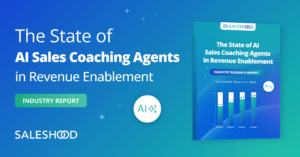
I think about it across four areas: Create. Coach. Guide. Engage.
Create: AI can help enablement teams turn existing knowledge, videos, documents, messaging, and product information into onboarding, learning, and certification programs much faster.
Coach: AI can provide sellers with continuous opportunities to practice, receive feedback, improve, and demonstrate readiness without requiring a manager for every interaction.
Guide: AI can make organizational knowledge and expertise available in the flow of work, helping sellers get the right answers and guidance when they need it.
Engage: AI can help sellers deliver more relevant experiences and guidance to buyers throughout the sales process.
Every one of these workflows has historically been limited by the same thing:
How much can our people realistically do? AI changes the answer. That’s why I believe we’ll continue to see enablement-to-seller ratios change. The goal isn’t to get to 1:1,000. The goal is to remove capacity as the constraint on impact.
The enablement role moves up the value chain
There’s another important consequence of this shift. If AI takes on more of the repetitive creation, delivery, practice, answering, and analysis, what happens to the enablement professional? I believe the role becomes more strategic.
We’re moving from an era of the Enablement Program Manager toward the Enablement Architect.
The traditional job required enablement teams to spend enormous amounts of time doing the work:
Building everything. Delivering everything. Answering everything. Chasing participation. Compiling reports.
The Enablement Architect has a different mandate.
They architect programs. They codify best practices. They orchestrate AI. They diagnose performance. They drive business change.
In other words, enablement becomes less about manually delivering every component of the system and more about designing the system that makes the revenue organization better.
That’s an exciting evolution for the profession. But it also comes with a warning.
Become an enablement architect. Not a software architect.
Generative AI has made it incredibly easy to build impressive prototypes. You can create an agent in an afternoon. You can connect a model to a knowledge base. You can prototype a coaching experience or internal assistant remarkably quickly. But a prototype isn’t an enterprise operating system. Once AI becomes part of how hundreds or thousands of people work, a different set of requirements emerges:
Governance. Security. Integrations. Maintenance. Scalability. Ongoing innovation.
Who has access to what? What data can the AI use? How are permissions maintained? How does it integrate with the CRM and other systems? What happens when an API changes? How do you monitor quality? How do you support thousands of users? Who maintains everything as models and technology evolve?
This doesn’t mean companies shouldn’t build. There are absolutely areas where proprietary AI can create competitive differentiation. Leaders should be deliberate about what they want their teams to own.
Enablement professionals should spend their time codifying what makes their organization great at selling, not unintentionally becoming responsible for maintaining an internal software platform.
Prototypes are easy. Operational maturity is hard. Build where it differentiates you. Buy where scale, reliability, governance, and ongoing innovation matter.
Efficiency isn’t enough. Measure the impact.
There’s one more change I believe enablement leaders need to make. If AI creates more capacity, we shouldn’t declare victory because we produced more training, created more content, or completed more coaching sessions.
More activity isn’t the goal. More impact is. I think about measurement across three levels:
Capacity → Performance → Business Impact
First, measure the capacity created. How many manager hours did we save? How much faster did we launch the program? How much SME or enablement time did we free up?
Then measure performance. Did sellers become proficient faster? Did readiness improve? Did the desired behaviors actually change? Are managers seeing better execution?
Finally, connect that improvement to business impact. Did sellers ramp faster? Did productivity improve? Did conversion increase? Did win rates move? Did revenue outcomes improve?
This is where AI can fundamentally elevate the enablement conversation.
Instead of saying:
“We trained 500 people.”
We should be able to say:
“We increased the capacity of our enablement organization, improved seller performance, and here is the measurable business impact it created.”
That’s a much more strategic conversation.
The denominator is changing
For years, one enablement professional for roughly every 100 sellers was treated as a reasonable benchmark. But 1:100 wasn’t a law. It was a capacity constraint. It reflected what a predominantly human-powered enablement organization could reasonably deliver.
AI changes that denominator.
We’re going to see organizations operate effectively at 1:250, 1:500, 1:1,000 and potentially beyond—not because enablement matters less, but because great enablement professionals will be able to extend their expertise further than ever before.
The organizations that get this right won’t simply use AI to reduce costs. They’ll use it to increase the capacity and impact of their people. I believe that’s the real opportunity in front of revenue enablement: Greater reach. Greater impact. Without proportional headcount.
Frequently Asked Questions (FAQs)
How is AI changing revenue enablement?
AI is changing revenue enablement by expanding the capacity of enablement teams. Instead of scaling primarily through additional headcount, teams can use AI to create programs faster, deliver more consistent coaching, make expertise easier to access, and provide guidance at scale. The result is greater reach and impact without requiring enablement headcount to grow at the same rate.
Will AI replace revenue enablement professionals?
AI is more likely to change the role than eliminate it. As AI takes on more repetitive creation, coaching, answering, and analysis, enablement professionals can spend more time architecting programs, codifying best practices, orchestrating AI, diagnosing performance, and driving business change. The role moves up the value chain.
How should enablement leaders measure the impact of AI?
Start by measuring three things: capacity, performance, and business impact. Look at how much human effort AI saves or expands, whether seller readiness and proficiency improve, and whether those changes translate into business outcomes such as faster ramp, higher productivity, better conversion, improved win rates, or revenue growth.