Key Takeways
- Traditional role play fails at scale because it depends entirely on manager availability and delivers inconsistent feedback, two conditions that cannot hold as a team grows.
- AI sales role play works because of the feedback loop it creates: salespeople practice, receive instant structured coaching, improve, and practice again.
- The teams winning with AI role play treat it as a daily coaching system, not a one-time onboarding exercise, and that distinction shows up in their win rates.
- As more of the buying process happens without a salesperson present, the conversations that do happen carry more weight, and preparation before those conversations is no longer optional.
What Is AI Role Playing?
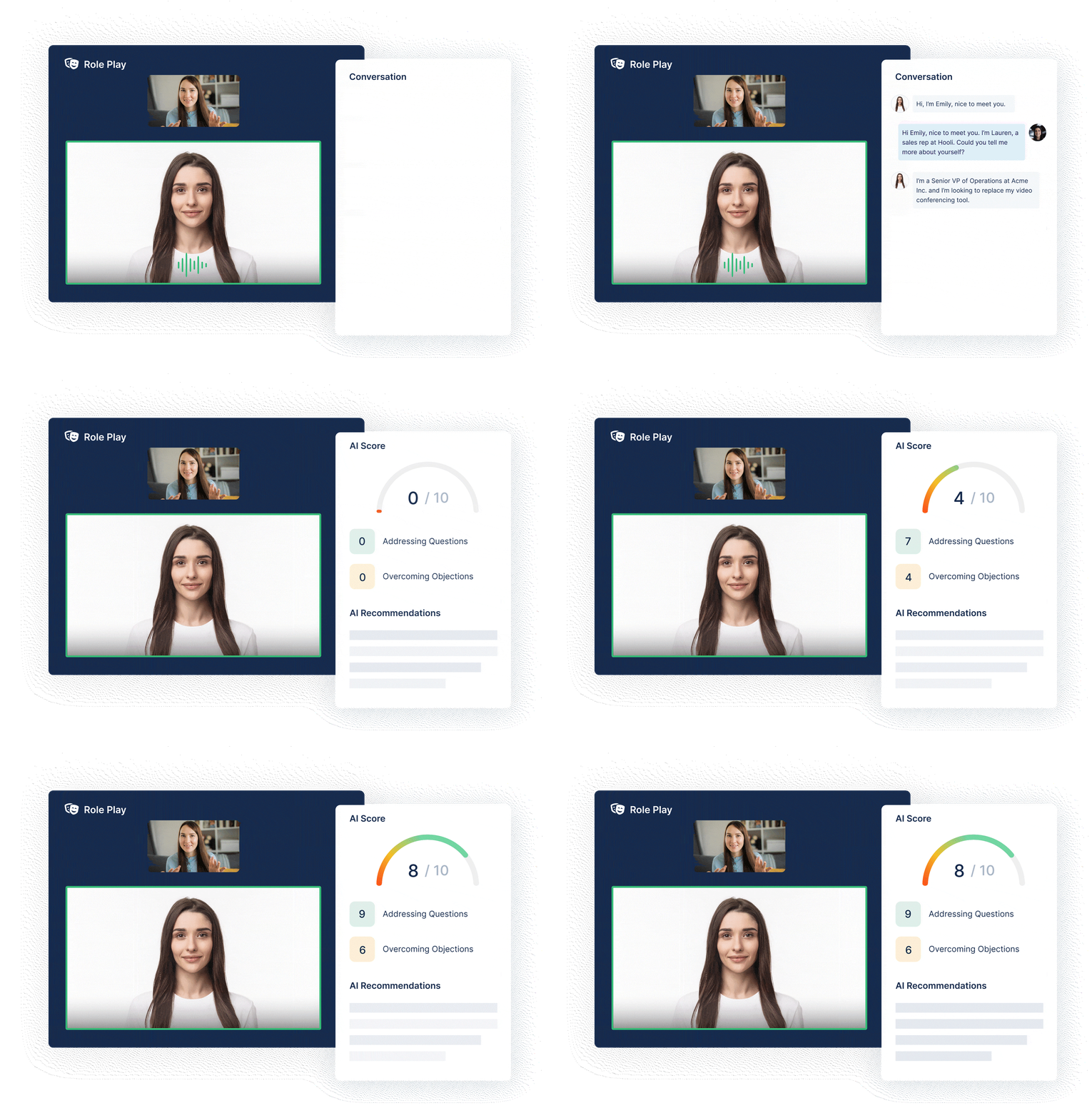
AI sales role play is a practice method that uses artificial intelligence to simulate realistic buyer conversations, delivering instant structured feedback to salespeople on every attempt. It is distinct from generic AI chatbots or recorded practice tools, which capture conversation without coaching it. The modern version places salespeople in adaptive simulations calibrated to specific selling scenarios, buyer personas, and the messaging the team is expected to execute, creating a repeatable practice environment that no manager can build at scale alone.
A sales manager built an entire quarter’s coaching plan around a new positioning message. He ran two hours of live role play at the sales kickoff. Two weeks later, he sat in on a discovery call and heard a salesperson lead with the old message, word for word. The new positioning never made it out of the kickoff room.
A readiness infrastructure problem, not a motivation problem, and it shows up in nearly every team that tries to scale a coaching program without a system behind it.
Why Is Traditional Sales Role Play Failing Sales Teams?
The fundamental problem with traditional role play is structural. When practice depends entirely on a manager’s calendar, you get two things reliably: infrequency and inconsistency. A manager with ten direct reports cannot run meaningful one-on-one practice before every important conversation.
AI Role Playing uses artificial intelligence to simulate real-world sales conversations in a safe, judgment-free practice environment. The old model cannot reproduce that environment at the volume and cadence a growing team requires.
Three specific failure points define the traditional model, and none of them can be fixed by asking managers to try harder.
- Manager bandwidth collapses under volume. A team of 12 requires 12 separate, meaningful coaching investments per cycle. Most managers genuinely coach two or three people well and give the rest surface-level feedback.
- Practice happens at the wrong moment. Skills that hold up in a real discovery call or late-stage negotiation develop through repetition before the moment arrives.
- Feedback is delayed, subjective, and inconsistent. Two managers assessing the same pitch will highlight different gaps, apply different standards, and coach toward different outcomes. That inconsistency compounds into messaging drift across the team.
Why Does AI Sales Role Play Matter More Than Ever?
Gartner’s March 2026 survey of 646 B2B buyers found that 67% now prefer a rep-free buying experience. When buyers are completing more of the purchase process before a salesperson is ever involved, the conversations that do happen carry more weight, and less room exists for a flat discovery or an unconvincing value proposition.
Buying committees have also grown. More stakeholders means more objection patterns, more conversations, and more messages that must land consistently across a team. AI role playing transforming sales enablement is the shift that connects all of these pressures into one argument for continuous practice.
How Is AI Sales Role Play Different From Traditional Sales Training?
Traditional sales training relies on workshops, live role plays, and post-call debriefs. These methods are valuable, but they are resource-heavy, hard to scale, and often lack follow-through.
The table below shows what changes when AI is inside the coaching loop rather than sitting outside it.
|
Traditional Role Play |
AI Sales Role Play |
|---|---|
|
Feedback arrives days or weeks after a practice session, when the moment has already passed. |
Feedback is delivered instantly after every submission, enabling immediate iteration. |
|
Practice depends on a manager’s calendar, which limits frequency and reach. |
Every salesperson practices independently and at their own pace, without depending on a manager’s calendar. |
|
Coaching quality varies by manager, producing inconsistent development across the team. |
Every salesperson receives the same structured, consistent feedback regardless of manager availability. |
|
Skill gaps surface only during deal reviews or after a lost opportunity, not before them. |
Managers gain team-wide skill visibility through dashboards without reviewing individual submissions. |
|
Skill development is episodic, tied to scheduled events rather than the daily rhythm of selling. |
Skill development is continuous and tied to a coaching cadence that runs alongside daily selling. |
How Does AI Sales Role Play Improve Coaching and Sales Readiness?
The most consistent gap in traditional coaching is volume. A manager can coach with great judgment but cannot be in every practice session for every salesperson. AI role play closes that gap by providing every salesperson with the same quality of coaching on every practice submission, on demand, without a calendar invite required.
According to our State of AI Sales Coaching in Revenue Enablement 2026, which analyzed 34,922 coaching submissions, top-performing teams averaged seven practice sessions per salesperson, practiced every three days, and reached 85% adoption. SalesHood’s AI Role Play is built around this feedback loop: practice, instant structured coaching, and practice again.
The manager’s role changes as a result. Rather than reviewing individual recordings, managers gain real-time visibility into where coaching investment is needed most. Research from our AI coaching programs shows managers save approximately 24 hours per month, and that time goes back into deal reviews and strategic conversations that genuinely require their judgment.
For a deeper look at how to design and run AI role play programs, download the Definitive Guide to AI Role Play in Sales.

What Are the Best Use Cases for AI Sales Practice?
The value of AI sales practice is highest wherever the consequences of an underprepared conversation are greatest. These are the five use cases where revenue teams see the most immediate impact:
- Onboarding new hires: AI role play compresses the window between a new salesperson’s start date and their first confident customer conversation. Teams using structured AI coaching programs see 40% faster time to readiness.
- SKO (sales kickoff) reinforcement: AI role play keeps new messaging alive after the event ends, replacing the drift that typically sets in within two weeks of the kickoff.
- Objection handling practice: Salespeople practice the most common objection patterns before they arrive in a real negotiation, building the fluency that turns a potential close into a familiar conversation.
- Demo and value articulation coaching: Our 2026 research found that 94% of AI coaching feedback pointed to clarity gaps and 87% to value articulation gaps, which are precisely the failures AI role play is built to fix.
- Ongoing messaging certification: When positioning shifts, AI role play certifies that every salesperson can articulate the updated message before carrying it into a customer conversation. This is everboarding in practice: the recognition that readiness does not end after onboarding, it continues as the business evolves.
Title: Boost Sales Performance with AI Role Play | DISQO & SalesHood Webinar
Elay Cohen and Amy Pence (DISQO) on rolling out AI role play across a live sales team. Published March 2025.
What Does the Evidence Say About AI Sales Role Play?
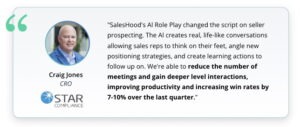
StarCompliance partnered with SalesHood to rebuild its sales training and coaching infrastructure using structured onboarding and AI-powered pitch practice to ensure their teams are well-prepared and confident in client interactions. The results were direct and measurable.
|
Customer Result: StarCompliance 2x average selling price increase. 17% increase in new logo win rates. 35% reduction in sales cycle. Craig Jones, Chief Revenue Officer, StarCompliance: “SalesHood streamlines our sales process and aligns our teams on messaging, leading to measurable improvements in our performance. The ability to double our average selling price and reduce our sales cycles by 35% has been a game changer.” |
Best Practices for Getting Started
Ready to try AI Role Playing? Here’s a step-by-step approach:
-
Identify Key Scenarios: Focus on common challenges like pricing objections, cold calls, and executive conversations.
-
Personalize Prompts: Use real-life language and situations to make simulations relevant and engaging.
-
Start Small: Test with a pilot group, gather feedback, and iterate.
-
Encourage Practice: Make AI sessions part of onboarding, team training, and SKO prep.
-
Track and Measure: Use AI insights to refine training and prove impact.
The most important step? Just start. Experiment. Learn by doing. See how the tech works. Your team will thank you.
How Do You Build an Effective AI Sales Role Play Program?
Building a program that produces measurable skill improvement requires five decisions made before the first practice session runs:
- Identify key scenarios first: Focus on the conversations that most directly determine deal outcomes: the first discovery call, the executive presentation, and the late-stage negotiation. Build those before building everything else.
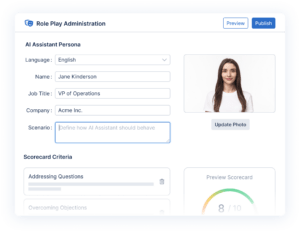
- Personalize coaching prompts to your buyer personas and competitive context: Use AI coaching agent prompts calibrated to your actual ICP (ideal customer profile), specific competitive objections, and current messaging for improvement that shows up in real conversations.
- Start with a pilot group: Test with a defined cohort, gather feedback, and iterate before rolling out to the full team. Adoption builds faster when early participants can speak to the experience from the inside.
- Set a practice cadence and hold it: Teams that practice every three days or fewer see meaningful skill progression. Seven sessions per salesperson per cycle is the benchmark. Build the cadence into the program before launch, not after adoption problems appear.
- Track and measure against business outcomes: Connect AI coaching scores and certification rates to win rates, ramp time, and pipeline progression. If your program cannot draw a line between practice activity and business outcomes, it is not being measured.
Title: How to Build AI Role Plays That Improve Rep Performance | Sales Enablement Demo
Step-by-step walkthrough on designing and launching high-impact AI role plays. Published February 2026.
What Should You Look for in an AI Sales Role Play Platform?
The buying landscape has grown quickly and capability claims from most platforms sound similar at a surface level. Five criteria separate purpose-built platforms from generic alternatives:
- Adaptive simulations tied to real selling scenarios. A static script with a fixed response set is not a simulation. It is a quiz.
- Structured, instant feedback calibrated to your messaging. Useful feedback names the specific moment value articulation broke down and gives the salesperson a concrete direction for the next attempt.
- Manager visibility without manual review. Team-wide dashboards that show progression and flag gaps direct coaching investment to where it matters most.
- Integration with the existing go-to-market stack. A role play tool that lives outside the workflow where salespeople already work faces an adoption ceiling before it launches.
- Everboarding design rather than onboarding-only deployment. Ongoing messaging certification, competitive response practice, and new play adoption all require a system that runs continuously, not one that ramps down after 90 days.
The Coaching Gap Is Closing. Which Side Are You On?
The revenue teams that will separate themselves over the next 18 months are not the ones with the most training content or the most enthusiastic kickoffs. They are the ones where every salesperson can walk into any buyer conversation, at any stage, and execute the right message without waiting for a manager to rescue the deal.
That kind of readiness does not come from episodic training. It comes from a continuous coaching system that gives every salesperson structured feedback at volume, builds skill through repetition, and gives managers the visibility to coach the moments that actually matter.
We built SalesHood as an Agentic AI Sales Enablement Platform for exactly this purpose: unifying content, learning, coaching, and buyer engagement in one system so the practice salespeople do on Thursday shows up in how they run their Friday conversation. If your team is still doing traditional coaching, the gap between your current readiness and what your buyers now expect is growing every quarter.
Book a demo and we will show you what a continuous coaching system looks like in production.
The question isn’t whether AI will become part of sales coaching. It already has. The question is whether your coaching system is helping every seller improve before the next customer conversation.
Frequently Asked Questions (FAQs)
What is the difference between AI role play and conversation intelligence tools?
Conversation intelligence tools like Gong and Chorus analyze calls that have already happened. AI role play happens before the call, giving salespeople structured practice so they arrive prepared rather than learning from a post-mortem. Both have a place in a coaching program, but only one of them changes what happens in the next conversation before it occurs.
How do you measure whether an AI role play program is working?
The leading indicators are practice cadence, completion rates, and AI coaching scores. The lagging indicators are the ones that matter to the board: win rates, ramp time, and average selling price. A program that cannot draw a line between practice activity and at least one business outcome within 90 days is either not being measured or not being used.
Is AI sales practice better than live role play with a manager?
AI sales practice and live manager coaching solve different problems and work best together. AI provides volume, consistency, and availability at scale. Live manager coaching provides strategic judgment and deal-specific context that AI cannot replicate. The most effective programs use AI coaching to handle the volume and redirect manager time to conversations that genuinely require their experience.
How quickly can a team launch an AI sales role-play program?
A focused program can be live within days for teams that start with a defined set of high-priority scenarios. Teams that begin with the five or six conversations that most directly determine deal outcomes build adoption faster and see measurable results sooner than teams that try to cover every use case at launch.