Key Takeaways
- Sales onboarding is broken. Most programs focus on content and completion, not performance and execution.
- Modern onboarding should mirror the sales process. Align training to how deals actually progress.
- The most effective ramp programs are stage-based. Cover Product Fluency, Meeting Excellence, Demo Excellence, MEDDICC, and Deal Execution.
- Practice, not content, drives performance. Role plays, real scenarios, and repetition are critical.
- AI coaching accelerates ramp by providing instant feedback, enabling continuous learning, and scaling practice
- Measure progression, not just completion. Track skill development, engagement, and real-world execution
- The ultimate goal is performance. Onboarding should lead to real pipeline, real deals, and faster time to productivity
Who This Is For
- Sales leaders building or rebuilding onboarding
- Enablement teams looking to modernize ramp
- Founders or CROs scaling a sales team
- Anyone frustrated with slow ramp and inconsistent performance
Sales Onboarding Is Broken
A lot has changed in the last 12–18 months. Companies have shifted from hiring freezes and cautious growth to more aggressive hiring again. Teams are expanding, pipelines are rebuilding, and expectations for performance are rising quickly. But while hiring has accelerated, most onboarding programs haven’t kept up.
This is the moment to step back and rethink your sales playbooks, sales processes, and how you actually ramp new sellers. What worked a few years ago, static sales training, one-time sales onboarding, content-heavy learning, is no longer enough.
We’re now operating in an AI-driven era where learning can be continuous, interactive, and personalized. Yet most AE sales ramp experiences still look the same:
- Information-heavy
- Disconnected from real deals
- Lacking reinforcement
- Slow to translate into actual performance
And the cost of this gap is massive.
Ramp times are still far too long. sales people take months, sometimes quarters, to become productive. Retention suffers. Performance is inconsistent. And for the business, that translates directly into lost revenue and missed opportunities.
Common Mistakes in Sales Onboarding
- Building training before defining the sales process
- Optimizing for completion instead of performance
- Over-relying on content instead of practice
- Not measuring progression or improvement
- Treating onboarding as a one-time event
The reality is simple:
Traditional onboarding optimizes for completion, not performance. What companies need instead is a modern AE onboarding experience that ensures sales teams:
- Retain what they learn
- Apply it in real selling situations
- Build confidence through practice
- Ramp faster and perform sooner
That’s the shift. At SalesHood, we set out to build an onboarding experience for ourselves designed for this new reality, one that is AI-driven, continuous, and tied directly to real execution in the flow of work. It’s not just training. It’s a s system for learning, practicing, and performing. We’re sharing our own internal best practices. Let us know which of our best practices improve your sales team’s performance.
Sales Onboarding Should Mirror the Sales Process
If there’s one principle that changed how we think about onboarding, it’s this: Sales 0nboarding should mirror the sales process.
Most companies get this backwards. They start by building onboarding programs, modules, content, sales certifications, without first ensuring that the foundation is solid. But you can’t build an effective ramping experience on top of a weak or outdated sales process.
It has to start with the buyer. It has to start with your sales process. Before you build onboarding, you need to ask:
- How current and relevant is our sales process?
- Are our stages clearly defined?
- Do we have clear exit criteria for each stage?
- What are the key activities sales teams must execute?
- What assets and content are used along the way?
- How does a deal actually progress from stage to stage?
Once that’s mapped out, clearly and intentionally, you have something powerful: A system that reflects how deals are actually won and nd that becomes the foundation for onboarding. From there, everything changes.
Instead of onboarding being a series of disconnected trainings, it becomes a progressive experience aligned to how sales teams actually sell. Sales teams learn the stages, practice the activities, and get assessed as they move from one stage to the next.
This is where AI becomes a force multiplier. With AI-driven role plays and coaching, you can:
- Simulate real selling scenarios
- Reinforce key activities at each stage
- Provide immediate feedback
- And ensure sales teams are building skills in a structured, repeatable way
That’s the shift. You’re no longer onboarding people to content, you’re onboarding them to execution. That was one of the biggest lessons we learned: If your onboarding doesn’t reflect how deals actually progress, your sales teams won’t either.
The Framework: A Stage-Based AE Ramp Plan
Once your sales process is clearly defined, onboarding becomes much simpler and much more effective. Instead of building training around topics, you build it around how deals actually progress. That’s exactly what we did.
We structured our AE ramping experience into a series of stages that mirror the sales process, with each stage focused on a specific set of skills, activities, and outcomes. Each stage in the ramping path follows a consistent, repeatable structure designed to reinforce learning and drive real skill development.
Every training begins with a clear introduction outlining expectations and learning goals, followed by focused content on a specific topic whether it’s a framework, process, product capability, or best practice. Teams then complete a knowledge check to validate understanding, followed by a practical exercise or scenario to apply what they’ve learned.
From there, the experience becomes more hands-on. Sellers practice articulating the message through an AI pitch, and then apply it in a realistic role play. This consistent flow — learn, test, apply, and practice — ensures reps build confidence, retain information, and develop the ability to execute in real customer conversations.
1. Product Fluency: Build Confidence and FoundationBefore sales teams can sell, they need to understand what they’re selling and how to position it. This stage focuses on:
But more importantly, it’s about confidence. Sales teams don’t just learn the product, they practice explaining it, showing it, and using it in context. AI Coaching: Sales teams are guided through progressive role play assessments to build confidence and competence. Here are some of the role playing assessments we developed for our team.
Outcome: Sales teams confidently talk about the product and connect it to customer value. |
Badge: Product Fluency
|
2. Meeting Excellence: Run Great First ConversationsThis stage is all about first meetings — where deals are either created or lost. sales teams learn how to:
This is where sales teams begin to control conversations, not just participate in them. AI Coaching: Here are some of the pitch practice and role play exercises that were developed for this section.
Outcome: Sales teams can run structured, high-quality discovery calls |
 |
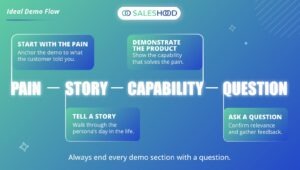
3. Demo Excellence: Turn Interest into MomentumDemos are one of the most critical moments in any deal — and one of the most misunderstood. This stage focuses on:
Sales teams learn a simple, repeatable flow: Pain → Story → Capability → Question Outcome: Sales teams can deliver demos that create alignment and move deals forward. |
 |

4. MEDDICC Training: Build and Qualify Real DealsAt this stage, sales teams move beyond skills and into real deal execution. They learn how to:
This is where sales teams start to build real pipeline with structure and discipline. Outcome: sales teams can qualify and manage real opportunities using the MEDDICC sales qualification framework Certification: MEDDICC |
 |
5. Deal Execution & Close: Win the Deal
The final stage is about turning a strong opportunity into a closed deal.
sales teams focus on:
- Aligning stakeholders
- Reinforcing value
- Packaging the deal (proposal, pricing, scope)
- Working cross-functionally with Customer Success
- Driving clear next steps to close
At this point, the goal is simple:
Get aligned, prove it, and get the deal done.
Outcome: sales teams can confidently drive deals to a decision.
Certification: From Training to Real PerformanceEach stage includes hands-on practice, role plays, and assessments not just content consumption. sales teams earn badges as they demonstrate proficiency:
But the most important milestone is the final one: Real Deal CertificationThis is where sales teams apply everything they’ve learned to progress and close an actual opportunity. Because the goal of onboarding isn’t to complete training. it’s to win real deals. This framework works because:
Most importantly: It turns onboarding into a system for execution, not just education. |
 |
What Makes This Different: Practice, AI, and Real Execution
Most onboarding programs focus on content. This one focuses on practice and performance. That’s the biggest difference. Instead of relying on static training and one-time sessions, this approach is built around:
- Role plays and real scenarios
- Continuous reinforcement
- AI-powered coaching and feedback
Sales teams aren’t just learning what to say, they’re practicing how to say it. With AI role plays, sales teams will:
- Simulate real customer conversations
- Practice discovery, demos, and deal progression
- Receive immediate, objective feedback
- Iterate and improve quickly
This creates a fundamentally different learning experience. Instead of waiting for a manager to review a call or provide coaching, salespeople get instant feedback at scale, allowing them to build confidence faster and refine their skills in real time.
Just as importantly, learning doesn’t stop after onboarding. It becomes continuous.
- Reinforcement huddles
- Ongoing role plays
- Deal-based coaching
- Real-time feedback loops
AI doesn’t replace coaching. It multiplies it. This is what makes onboarding stick. sales teams don’t just complete training, they build muscle memory through repetition and feedback.
How to Measure Success: From Leading Indicators to Revenue Outcomes
| One of the biggest gaps in most onboarding programs is measurement. Companies track completion, but not progression. They track activity but not performance. If you want onboarding to actually drive results, you need to measure both leading and lagging indicators. |  |
Leading Indicators: Are Reps Learning and Improving?
Early on, you’re not measuring revenue, you’re measuring engagement, progression, and skill development. Start with the basics:
- Path completion
- Path progression
- Training completion
These are table stakes. But the real signal comes from how reps are performing within the experience. You should be looking at:
- Engagement levels: How actively are they participating?
- Test scores: Are they understanding key concepts?
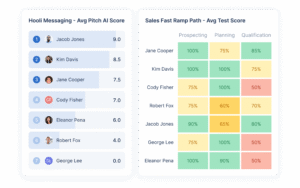
- AI practice feedback scores: How are they improving in structured exercises?
- AI role play scores: Are they developing real conversational skills?
And most importantly: Are they getting better over time?
This is where the system becomes powerful. You can track progression, not just completion. You can actually watch reps improve as they move through the path.
Another strong signal: Number of attempts
Reps who take the time to retry, refine, and improve are typically the ones who ramp faster and perform better. It’s a clear indicator of effort, engagement, and seriousness.
Transition Metrics: Are They Applying What They Learned?
As reps move through the path, the focus shifts from learning to execution. Now you want to see:
- Outreach activity: Are they confidently engaging prospects?
- Pipeline creation: Are they generating opportunities?
- Call quality: Are they running structured, high-quality conversations?
Call quality is especially important. With conversation intelligence, you can evaluate:
- How well reps are applying your sales stages
- Whether they’re asking the right questions
- How effectively they’re progressing deals
This is where training meets reality.
Lagging Indicators: Are They Driving Results?
Ultimately, onboarding success should show up in business outcomes. That means tracking:
- Win rates
- Quota attainment
- Time to productivity
These are the metrics that matter most to the business. But they only improve if the leading indicators are strong.
Setting the Right Expectations
It’s important to define success early. In a ramp environment, that means setting realistic, achievable goals. For example:
- Early pipeline targets
- First opportunities created
- Initial deal progression milestones
- Ramp quota expectations in the first 1–2 quarters
These will vary depending on segment, deal size, and sales cycle but the principle is the same: Give your team clear, achievable targets that build confidence and momentum.
The Big Shift
Most onboarding programs ask: “Did they complete the training?”
Modern onboarding asks: “Are they improving, and are they performing?”
That’s the difference between tracking activity and building a system that drives results.