Key Takeaways
- Sales content management aligns teams, content, and coaching into a single execution system
- Unified platforms like SalesHood eliminate content chaos and drive consistent adoption
- Analytics and AI make content strategy measurable, scalable, and revenue-linked
The hidden cost of poor content management shows up everywhere: in lost deals, wasted effort, and painfully low content adoption.
Reps waste time searching for the right assets. Managers struggle to enforce consistency. Buyers receive outdated or irrelevant information at critical moments. The root problem isn’t a lack of content but content chaos powered by disconnected tools and broken workflows.
This article is a deep dive into sales content management. We will explore what it really means, how modern frameworks work, and the best practices that unify people, content, and technology into one sales execution system.
What is Sales Content Management and Why it Matters
So what is sales content management? It’s the system that ensures reps always have the right content, at the right time, for the right buyer and you can actually see what’s working.
Unlike marketing content management (built for publishing), sales content management is built for execution inside live deals. Without it, teams hit the usual traps: content chaos, inconsistent messaging, no visibility into performance, and low adoption. Reps stop trusting the content, managers can’t prove impact, and buyers get mixed signals.
This shift is what turns content into a revenue asset. Here’s how it differs from a traditional CMS:
|
Traditional CMS |
Sales Content Management Platform |
|
Built for publishing |
Built for selling |
|
Static content storage |
Contextual, deal-stage delivery |
|
Limited performance insight |
Revenue-linked analytics |
|
No rep coaching |
Integrated training & guidance |
The Core Sales Content Pillars
From the SalesHood point of view, effective sales content management isn’t about dumping files into a repository. It’s about structuring content across six core pillars, each designed to support specific moments in the selling journey:
- Foundational messaging & positioning content: Defines your narrative, ICP, value propositions, and differentiation.
- Product and technical content: Demos, specs, integrations, and feature deep dives.
- Enablement content (playbooks, battle-cards, objection handling): Guides reps through competitive situations and key friction points.
- Buyer-facing and deal support content: Proposals, one-pagers, pricing, and validation assets.
- Proof & validation content: Case studies, testimonials, and ROI proof.
- Training, coaching, and readiness content: Onboarding programs, certifications, and skill development resources.
Platforms like SalesHood unify all six pillars into the sales workflow by connecting content, coaching, and access where selling actually happens.

How to Map Sales Content to Your Sales Process
Most teams don’t struggle because they lack content; they struggle because their content doesn’t align with buyer intent or funnel stage. Effective mapping follows a simple but powerful framework:
Persona → Problem → Content → Action → Measure.
Each buyer persona enters the funnel with a specific problem. Your content must match that moment, drive the right next action, and be measured for real impact. When any part of this chain breaks, engagement drops and momentum stalls.
This is where a sales enablement tool becomes the foundation of scalable execution. It ensures the right content supports the right conversation at the right time – consistently, across every rep and every deal.
The Sales Content Lifecycle Model
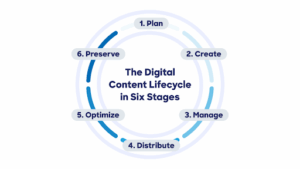
Sales content only drives revenue when it’s managed as a continuous lifecycle, not a one-time upload. A modern lifecycle moves through six connected stages:
- Plan: Define content goals, ownership, and success metrics before creation begins.
- Create: Sales, marketing, and enablement collaborate to build purpose-driven assets.
- Organize/Manage: Apply taxonomy, tagging, and metadata so content is searchable and stage-aware.
- Distribute: Make content accessible directly inside CRM and inbox workflows.
- Activate: Embed training, practice, and coaching into real selling moments.
- Measure & Optimize: Track usage, engagement, and retire underperforming or outdated content.
Strong metadata & analytics are what turn this lifecycle into a system of continuous improvement.
Key Features of a Modern Sales Content Management Platform
A modern sales content management platform must do far more than store files, it must actively guide revenue execution. AI-powered search ensures reps find the right asset in seconds, not minutes. Just-in-time content guidance delivers exactly what sellers need based on deal stage and buyer behavior.
Seamless CRM and inbox integration embeds content directly into daily workflows, eliminating context switching. And robust reporting reveal which assets influence deals, which content accelerates progression, and where gaps still exist.
When these capabilities work together, content becomes an operating system for sales. Platforms like SalesHood make this execution scalable, measurable, and repeatable across the entire revenue organization.
Common Challenges and How to Solve Them
Even well-funded teams struggle with the same five content problems:
- Outdated content erodes buyer trust. Solve this with automated aging and review cycles.
- Content overload overwhelms reps. Fix it through strict curation and role-based access.
- No clear ownership leads to chaos. Assign business owners to every asset.
- A lack of training prevents adoption. To solve this, embed content into certifications, roleplay, and live coaching.
- Poor workflow integration kills usage. So content must live inside CRM, email, and sales tools where reps already work.
When these issues are addressed systematically, sales content stops being a liability and becomes a measurable revenue driver.
Top Sales Content Management Tools for Modern Sales Teams
Sales teams today choose from several categories of tools, each solving a different part of the content challenge.
- A traditional CMS is built for publishing, not selling.
- A CRM extension adds basic document sharing but lacks enablement depth.
- A DAM (Digital Asset Management) system focuses on storage and brand control, not revenue execution.
An emerging AI layer adds intelligence to search and recommendations, but often sits disconnected from daily selling.
The most effective option for modern revenue teams is the enablement platform, which unifies content, training, coaching, and analytics into one workflow. SalesHood fits into this “unified platforms” category, designed specifically to connect content execution directly to sales performance and revenue impact.
Benefits of a Unified Content Management Strategy
When content, coaching, and access are unified, the impact shows up quickly across the funnel. Teams see faster onboarding because new reps learn from real, in-workflow content, and not scattered folders.
Adoption increases because content is easier to find, trust, and use. Buyer engagement improves when the right assets are delivered at the right moment. And with clear attribution, revenue leaders finally see which content influences wins and which doesn’t.
The Future of Sales Content Management
The future of sales content management is being shaped by AI-first execution. Future AI assistants will transform how reps search, tag, and discover content by removing friction entirely. Predictive content recommendations will serve the next-best asset based on buyer behavior and deal context. Personalized buyer journeys will replace one-size-fits-all sales motions.
Most importantly, always-on coaching will be directly tied to content usage, connecting what reps share, how buyers respond, and where skill gaps exist in real time. This convergence marks a fundamental shift: AI will no longer just support content. It will orchestrate how content, coaching, and enablement operate together inside intelligent revenue workflows.
Want to see how SalesHood makes content actionable, measurable, and directly tied to revenue? Request a demo today.
Frequently Asked Questions (FAQs)
Q: What makes sales content management different from traditional content systems?
Traditional systems are built for publishing and storage, while sales content management is designed for live selling. It delivers the right content by deal stage, buyer intent, and role, with built-in performance tracking.
Q: How does a sales content management platform improve performance?
It improves performance by increasing content adoption, enabling just-in-time guidance, aligning content with coaching, and providing analytics that show which assets actually drive deals forward.
Q: What are the best metrics to measure sales content effectiveness?
Key metrics include content utilization rate, time-to-first-use, content-influenced win rate, buyer engagement heatmaps, and content aging or retirement cycles.