Key Takeaways
- AI sales enablement changes six jobs: content, training, coaching and practice, guided selling, buyer engagement, and measurement.
- AI role play is where most teams begin. In SalesHood’s State of AI Sales Coaching report, pitch practice was 39% of AI coaching use, and seller scores rose about 38% across four practice attempts.
- The biggest change is capacity: a small enablement team can support a large sales team without adding headcount at the same rate.
- Judge AI sales enablement platforms on whether reps use the AI every week, whether it works from your own content and methodology, and whether it ties practice to deal outcomes.
Last updated: October 15, 2026
| What is AI sales enablement? AI sales enablement is the use of AI to help sellers find content, learn, practice conversations, and engage buyers, and to help enablement teams build programs faster and see what works. It spans AI search, AI course building, AI coaching and role play, guided selling, and digital sales rooms. It supports sellers and managers. It doesn’t replace them. |
Picture an enablement leader the week before a product launch. There’s new messaging, 150 reps across three regions, and no manager time for role plays. The usual plan is a recorded webinar and a deck in the shared drive. A month later, half the team still pitches the old story.
AI sales enablement changes that week. The deck becomes a short course in an afternoon. Every rep practices the new pitch with an AI buyer and gets feedback that night, and the manager sees who is ready. This guide covers what AI in sales enablement does for each part of the job, what the research and customers show, and how to evaluate AI sales enablement platforms.
How Is AI Sales Enablement Different From Traditional Enablement?
Traditional sales enablement scales with people: more programs need more program managers, and more coaching needs more manager hours. AI sales enablement scales with software. AI drafts the course, runs the practice session, scores the attempt, and finds the answer, so enablement leaders and managers spend their time on judgment work.
Practice, reinforcement, and coaching are what make training stick, and they cost the most human time. (For the fundamentals, see our guide to sales enablement.) A Gartner survey also found that sellers who partner effectively with AI tools are 3.7 times more likely to meet quota.
| Enablement job | Traditional approach | With AI sales enablement |
|---|---|---|
| Content and search | Folders and tags; reps ask in Slack | AI search returns the answer and the asset in the flow of work |
| Training and onboarding | Courses built by hand over weeks | AI drafts courses and quizzes from existing decks, docs, and call recordings |
| Coaching and role play | Manager-led role play, when managers have time | AI role play for every rep, with instant feedback and scoring |
| Guided selling | Static playbooks reps rarely open | Guidance tied to the deal stage, moving toward deal-specific AI guidance |
| Buyer engagement | Email attachments with no visibility | Digital sales rooms with engagement signals and buyer answers |
| Measurement | Completions and attendance | Skill scores, practice data, and content tied to deal outcomes |
How Does AI Change Sales Content and Search?
AI changes sales content by making it findable in the moment a rep needs it. Instead of browsing folders, a rep asks a question in plain language and gets an answer drawn from approved content, with the source asset attached. Enablement teams also use AI to spot stale content and see which assets buyers actually open.
Content goes unused when reps can’t find it or what they find is out of date. AI search fixes the first. The second still needs a person, and AI helps by flagging content that is unused, missing context, or expiring.
What to look for: answers that cite the source asset, search that respects permissions, and sync with where your content already lives, such as SharePoint or Google Drive.
How Does AI Change Training, Onboarding, and Course Building?
AI changes training by cutting the time it takes to build it. An enablement leader can turn a product deck, a methodology guide, or a call transcript into a draft course, with the modules laid out in order, in hours instead of weeks. The leader still reviews and edits, but starts from a draft instead of a blank page.
Speed matters most when messaging changes often. If a launch takes a month to reach the field, reps sell the old story for a month. With AI course building, enablement can release short modules every time something changes, and onboarding becomes a set of small, current lessons. For more on ramping new hires, see How AI Sales Training Improves Ramp Time and Readiness.
How Do AI Sales Coaching and AI Role Play Work?
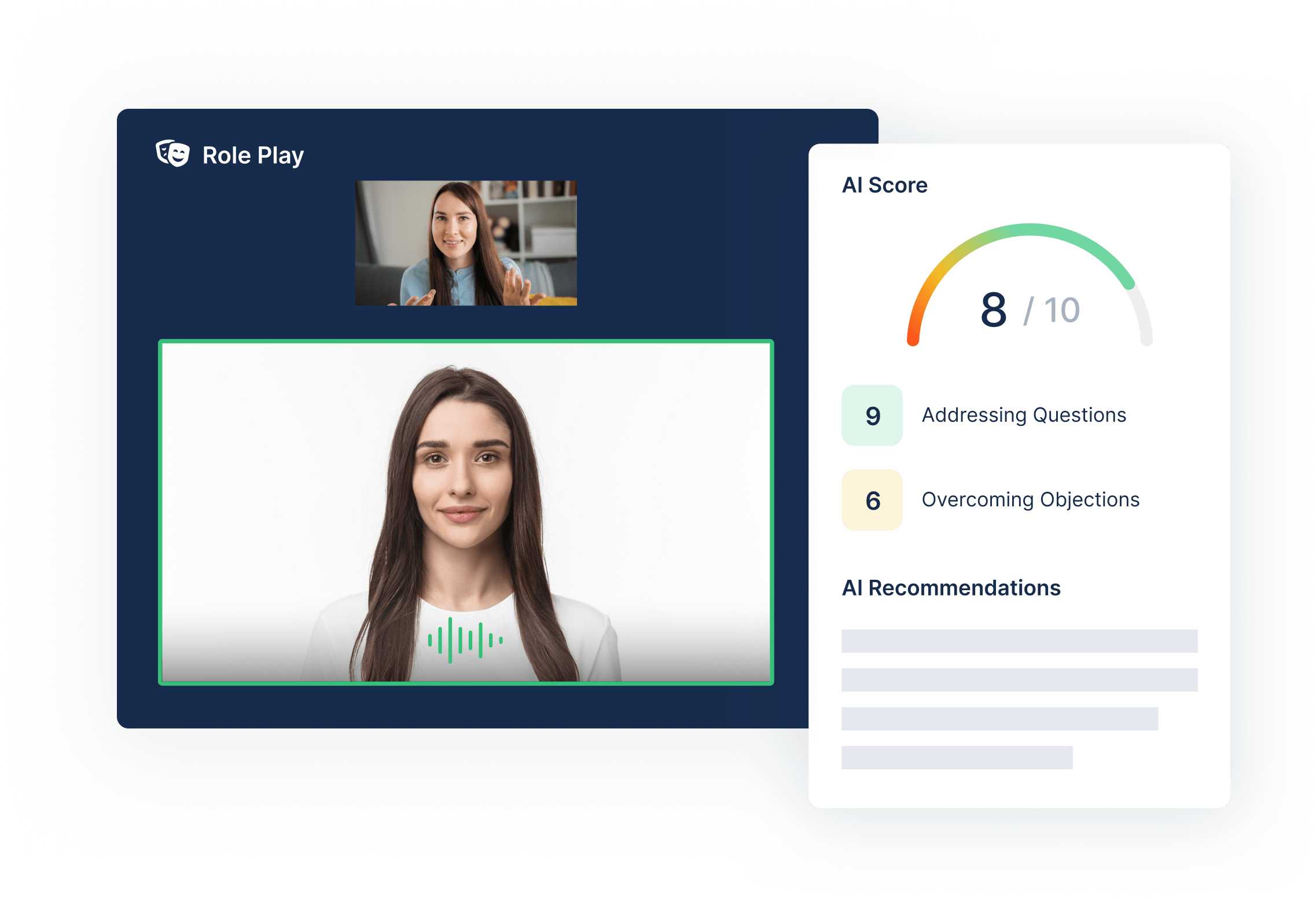
AI sales coaching gives every rep a practice partner and a coach on demand. In AI role play, the rep talks to an AI buyer built from a real scenario, such as a skeptical CFO or a competitive objection. The AI then scores the conversation against a rubric and gives specific feedback on what to change.
The reason this works is volume. A manager with eight reps can’t run weekly role plays with each one. AI can, at any hour, and managers spend their time on the reps and skills that aren’t improving.
Good AI role play depends on the scenario. SalesHood’s research found that strong programs define the context (the situation and the rep’s role), the character (a realistic buyer), and the coaching (the skill and what good sounds like). Our AI sales role play guide goes deeper on building scenarios that reps take seriously.
How Does AI Change Guided Selling?
Guided selling puts the right talk track, content, and next step in front of a rep at each stage of a deal. Most guided selling today matches content to the deal stage, industry, and product in the CRM. AI is starting to make that guidance specific to each deal, drawing on calls, buyer activity, and the team’s methodology.
Guided selling is where enablement meets execution. A methodology rollout like MEDDICC fails when it lives only in training. It works when the qualification questions and the right case study appear while a rep prepares for a call.
What to look for: guidance inside the CRM where reps already work, playbooks your team can edit without a services project, and data on which plays reps use. Ask vendors which parts of their guided selling use AI today and which are on the roadmap.
How Does AI Change Digital Sales Rooms and Buyer Engagement?
AI changes buyer engagement by making it measurable and faster to set up. Reps build a digital sales room for each deal in minutes, with tailored content and a mutual action plan, and AI helps buyers find answers inside the room. Sellers see who engaged, with what, and when, so they follow up on signals instead of guesses.
This matters because B2B buying groups are large, and most of the decision happens when the seller isn’t in the room. Engagement signals show whether a deal has a real buying group behind it or a single champion who has gone quiet.
For a full primer, read What Is a Digital Sales Room?
How Does AI Change Enablement Measurement?
AI changes measurement by capturing skill data, not just completion data. Every AI practice session produces a score, every search shows what reps need, and every digital sales room records buyer engagement. With that data in the CRM, enablement leaders can report readiness and content use next to win rates, ramp time, and deal size.
Completion rates tell you a rep clicked through a course. Practice scores tell you whether the rep can deliver the pitch. Engagement data tells you whether buyers responded. Our guide to sales enablement KPIs lists the metrics executives recognize.
AI Sales Enablement Examples
Here is how four SalesHood customers use AI sales enablement today. The numbers and quotes come from each customer’s published story or recorded webinar.
Tufin: a team of one, and new messaging in the field in weeks
Tufin runs enablement with one person, Patrick Pyett, for a technical sales team whose messaging changes fast. Reps had stopped trusting content that went out of date. Tufin now syncs its SharePoint content into role-based plays, and AI role plays let reps practice each new message before it reaches a customer. Weekly engagement climbed from 30% to 90%, and new messaging now reaches the field in one to two weeks, down from a month or more.
“We’re able to take what comes from our product… get that into a role play, get that out in front of our sales team in a week, maybe two weeks, and that used to take us a month or more.”
 Patrick PyettGlobal Head of Sales Enablement, Tufin
Read the full story: How Tufin increased enablement adoption from 30% to 90% with AI role plays.
Veritiv: 1,200 sellers and a new program every six weeks
Veritiv sells a wide range of products, which is a lot for 1,200 sellers to know. SalesHood puts every pitch deck and battle book in front of reps, and AI role plays coach and certify each one. Veritiv now launches a new go-to-market program every six weeks instead of one or two a year, with about 25 people supporting enablement for all 1,200 sellers.
“We’re rolling out new go-to-market programs that would have taken a year that we can now do in six weeks.”
 Chris BradleyChief Marketing Officer and Head of AI Transformation, Veritiv
Copado: AI coaching and digital sales rooms in one program
Copado needed better win rates on new and add-on deals across a big sales team in a competitive market. It brought Client Sites (now Digital Sales Rooms), MEDDICC training, content sharing, and AI coaching on new messaging together in SalesHood. Sellers who use Client Sites win 67% more often than those who don’t, average selling price is up 25%, and rep participation rose 33%.
“Within 90 days of using SalesHood, we realized improvements in win rates, ASP, and more sellers closing deals. The platform continues to drive improvements across our sales productivity metrics.”
 John GuerriereDirector, Sales Enablement, Copado
SmartRecruiters: buyer engagement as a deal signal
SmartRecruiters reps were sharing outdated content with no data on what buyers saw. Account executives and solution consultants now build a Digital Sales Room for each prospect. Deals that include a room are 4X larger, buyers are 2X more likely to buy, and won deals show 10X the content engagement of lost deals, so reps qualify out sooner.
“Digital Sales Rooms are a great barometer of pipeline health sharing deal insights of greatness or red flags based on buyer engagement.”
 Caitlin BrannanDirector, Revenue Enablement, SmartRecruiters
More examples are on our customer stories page.
What Does the Research Say About AI in Sales Enablement?
SalesHood’s research points to one pattern: AI coaching works when practice becomes a habit. The findings below come from The State of AI Sales Coaching in Revenue Enablement 2026, SalesHood Research’s analysis of AI coaching programs run in SalesHood from January to December 2025. They are report findings across the dataset, not results from any single customer.
The dataset covers 34,922 coaching submissions from about 10,000 sellers at 45 organizations, across roughly 1,000 AI coaching agents and more than 400 coaching programs. Here is what it shows:
- Practice improves skills. Across four practice attempts, average seller scores rose from 6.1 to 8.4 out of 10, an improvement of about 38%.
- Teams start with the pitch. Pitch practice was 39% of AI coaching use, followed by sales execution skills like negotiation and closing (20%), demo practice (16%), discovery (6%), and objection handling (3%).
- Practice is frequent when it’s easy. Reps submitted an average of 5 practice sessions a month and came back to practice every 3 days, with 70% average rep participation.
- The gap is value, not product knowledge. In more than 3.5 million words of AI feedback, the most common guidance was about clarity (94% of feedback entries), value articulation (87%), and guiding the buyer to next steps (70%).
- High performers practice weekly. The report’s benchmark for high-performing teams is 85% rep participation and one to two coaching sessions per rep each week.
The takeaway: start with the pitch, then move practice deeper into the deal, into discovery, objections, and negotiation.
Download the State of AI Sales Coaching report for the full benchmarks, use cases, and program design framework.
How to Evaluate AI Sales Enablement Platforms
Evaluate AI sales enablement platforms on adoption and outcomes, not on the length of its AI feature list. Every vendor now offers AI search and AI role play. The differences are whether reps use the AI every week, whether it works from your content and methodology, and whether you can prove it moved deals.
Use these eight criteria:
- Weekly use by reps. Ask for adoption data from a customer of your size, and check G2 reviews for ease of use and user adoption.
- AI grounded in your content. Answers, courses, and role play scenarios should come from your approved content, your messaging, and your methodology, with sources shown.
- Realistic role play and useful feedback. Try a role play yourself. The AI buyer should push back the way your buyers do.
- One platform for content, training, coaching, and buyer engagement. When these live in separate tools, reps get more logins and leaders get data that doesn’t connect.
- Time to value for a small team. If enablement is one or two people, ask how long setup takes and who maintains the AI scenarios and content after launch.
- Manager visibility. Managers should see who practiced, how they scored, and where to coach, without reviewing every session.
- Proof of impact. The platform should connect practice, content use, and buyer engagement to win rate, ramp time, and deal size.
- Security, governance, and integrations. Check data handling for AI features, content audit controls, single sign-on, and connections to your CRM, content stores, and the AI tools your team already uses.
Comparing tools?
Our honest comparison of sales enablement platforms lays out the options for growing teams and who each one fits.
Where SalesHood’s AI Fits in Your Enablement Program
SalesHood is the AI-Powered Revenue Enablement Platform, and its AI covers three of the jobs in this guide: coaching and role play, course building, and search. Reps practice with an AI buyer and get graded, enablement turns files or call transcripts into courses, and everyone asks questions of approved content.
AI coaching and role play. A rep runs a pitch, a discovery call, or an objection against an AI buyer built from your scenario. The AI grades each attempt against your rubric and explains what to change, and managers see the scores across the team, so their coaching time goes to the reps who need it.
AI course building. Upload a launch deck, a methodology guide, or a call transcript, and SalesHood drafts a course with the modules in order. Enablement reviews and edits the draft, so a team of one or two can keep training as current as the messaging.
AI search. Reps type a question in plain language and get an answer drawn from your approved content, without digging through folders or asking in Slack.
On G2, SalesHood holds a 4.6-star rating from 828 verified reviews and is a Fall 2026 Leader in Sales Coaching and a High Performer in AI Sales Roleplay Tools.
If you want to see what AI role play and AI course building look like on your own content, book a SalesHood demo and bring a deck from your next launch.
What to Do Next
Pick the one job where AI saves the most human time and start there. For most teams that job is practice: put your newest pitch into an AI role play, ask every rep to run it this week, and compare their scores with how their next calls go. Once practice is a habit, add AI course building for your next launch and AI search for the questions reps ask most. Then report the program in skill scores and deal outcomes, not completions.
Frequently Asked Questions (FAQs)
What is AI sales enablement?
AI sales enablement is the use of AI to help sellers find content, learn, practice, and engage buyers, and to help enablement teams build programs and measure what works.
How is AI used in sales enablement?
Teams use AI to answer reps’ questions from approved content, draft training, run AI role play with instant feedback, and show buyer engagement in digital sales rooms.
What are AI sales enablement platforms?
AI sales enablement platforms put content, training, coaching, guided selling, and buyer engagement in one place, with AI built in. Unlike a standalone AI tool, they work from your content and your team’s data, and results show up in one set of reports.
What is the difference between AI sales coaching and AI role play?
AI role play is the practice: a rep has a conversation with an AI buyer. AI sales coaching is the feedback: scoring the conversation, pointing out what to change, and showing managers who needs attention.
Will AI replace sales enablement teams?
No. AI takes on work that doesn’t need judgment, like drafting courses, running practice, and finding content. Enablement leaders still decide what to teach and how to measure success.
How do you measure the ROI of AI sales enablement?
Track practice participation, skill scores, and content use alongside ramp time, win rate, and deal size. Compare reps who use the AI with those who don’t, and count the hours enablement and managers save.