Key Takeaways
- Modern sales enablement is built around five guiding principles: buyer-centric, data-driven, just-in-time, go-to-market aligned, and seller-friendly.
- The biggest barriers to sales performance are structural, including inconsistent processes, misaligned content, and bloated tech stacks that drag salespeople away from selling.
- Customer evidence shows the impact of strong enablement programs, with companies like Copado, StarCompliance, and SmartRecruiters reporting measurable lifts in win rates, deal size, and sales cycle speed.
- AI is shifting enablement from event-based training to continuous coaching, with teams running AI programs launching 3x faster and improving seller skills by up to 38%.
What is sales enablement?
Sales enablement is the strategic discipline of equipping salespeople with the content, training, coaching, and tools they need to engage buyers and close deals consistently. Unlike sales training, which is event-based, or sales operations, which manages systems and processes, sales enablement focuses on field readiness and execution across the full buyer journey. Modern sales enablement is continuous, AI-assisted, and tied directly to revenue outcomes such as win rate, ramp time, and quota attainment.
A few years ago, I sat with a CRO who had just missed quota for the third quarter in a row. His team had every tool you can think of, a CRM, a conversation intelligence platform, a content library, and a learning system.
What they did not have was a way to make any of it show up in the moments that mattered. His salespeople could not find the right deck, his managers could not coach forty people each, and his new hires were taking nine months to ramp. The investment was there but the execution was not.
That gap is what sales enablement exists to close. This guide explains what sales enablement is, why it matters more in 2026 than ever before, and how the best revenue teams are turning enablement from a support function into a measurable revenue engine.
“The essence of Sales Enablement is to help companies grow their business faster by aligning their people, processes, and priorities.” – Elay Cohen, CEO of SalesHood, Author Enablement Mastery
Sales enablement continues to evolve and mature rapidly. The pandemic has changed the way we sell forever. Organizations are forced to make drastic changes to their sales enablement programs, focusing on virtual enablement and virtual selling. Having a sales enablement program is no longer an option. It’s a must-have business imperative. When you can unlock the power of sales enablement through an optimized sales enablement strategy that includes onboarding and new hire training, modeling, pitch practice, and feedback–something really magical happens. All of your revenue teams are aligned with the same messaging, same pitch, and the same strategy. It’s a beautiful thing.
|
In this sales enablement guide you’ll learn about the strategies, benefits and best practices to follow to improve win-rates, sales cycles time and sales productivity. |
How does sales enablement work in a modern revenue team?Sales enablement works by sitting between go-to-market strategy and field execution, and turning one into the other. The function takes the company’s positioning, pricing, sales process, and product story, and translates it into the daily actions of every salesperson: the pitch they deliver, the deck they send, the questions they ask in discovery, and the way they handle a pricing objection. When enablement is working, the way the company says it sells matches the way it sells in the field. The job has three parts:
The shift in how this function is built has been significant. Traditional platforms prioritized content storage, which made finding the right asset the bottleneck. Modern sales enablement is built around content activation. While competitors like Highspot and Seismic offer extensive libraries, SalesHood’s Agentic AI Sales Enablement Platform combines intelligent discovery with real-time coaching and AI role play in one execution layer. Salespeople spend less time searching and more time selling. Managers coach faster. Enablement teams measure what drives results. Done well, this work produces higher win rates, shorter sales cycles, and improved quota attainment. |
|
Interested in taking a free Sales Enablement Mastery course, sign up here to uplevel how you’re doing enablement today.

Why does sales enablement matter more than ever?
Sales enablement matters because the pressure on revenue teams has never been higher, and the gap between effort and outcome has never been wider. Three data points show how structural the problem has become:
- According to the 2025 GTM Benchmarks Report from Ebsta and Pavilion, based on analysis of $48 billion in pipeline data, 78% of salespeople missed their quotas in 2025, up from 69% in 2024. Quota attainment is not just declining but also accelerating in the wrong direction.
- The performance gap inside teams is just as significant. The same Ebsta and Pavilion report found that top performers now close deals 11 times faster than their lower-performing counterparts, up from 8.9 times in 2024. When a small group of high performers carries most of the revenue, the team is one resignation away from missing the number.
- The buyer side has gotten harder at the same time. Forrester’s 2025 B2B predictions report found that more than half of large B2B transactions over $1 million will move through digital self-serve channels, and Millennial and Gen Z buyers are involving an average of ten external influencers before they ever talk to a salesperson. The window for a salesperson to add real value has narrowed, and the moments inside that window have to land.
Sales enablement is the function built to close all three gaps. Teams that treat enablement as an event keep paying for the same problems. Teams that treat it as a continuous, data-backed system are pulling ahead.
Seven benefits of sales enablement
Sales enablement transforms how revenue teams operate when it is implemented thoughtfully and reinforced consistently. The seven benefits below explain why enablement now sits at the center of modern revenue strategy.
1. Faster ramp time for new sales hires
Sales enablement accelerates onboarding, helping new reps become productive faster. Case study after case study shows that companies using enablement platforms reduce time to ramp and hit quota more quickly—all in a fully virtual environment. Traditional in-person bootcamps are no longer feasible for many teams. Sales enablement platforms provide scalable, virtual onboarding experiences that engage reps from day one—no flights required.
Watch the video to learn the guiding principles of new hire sales onboarding. Download the Essential Guide to Sales Onboarding.
 |
Case study: Sales onboarding in actionLindsey Morga, Revenue Enablement Manager, shares how her team pivoted to a 100% remote onboarding program overnight—and saw faster time to productivity as a result. Her insights are a must-read for companies modernizing their ramp process. |
2. Stronger sales and marketing alignment
When sales enablement becomes a company-wide priority, alignment between sales and marketing improves dramatically. Content creation becomes more intentional, communication flows more easily, and sales productivity increases.
Instead of finger-pointing—marketing wondering why content isn’t used, and sales complaining about irrelevant assets—teams collaborate around shared goals: consistent messaging, customer experience, and revenue growth.
Read more: Sales and Marketing Alignment with Sales Enablement blog.
3. More effective sales content
|
A unified go-to-market strategy means every employee, especially every seller, can clearly answer: What does your company do—and why does it matter? For sales reps, content effectiveness hinges on being able to confidently pitch, personalize, and deliver value. Sales enablement ensures the pitch is practiced, relevant, and aligned with the buyer’s needs at every stage. Download the guiding principles for Sales Content Management. |
 |
4. Messaging alignment at scale
Consistent messaging doesn’t happen by accident—it’s the result of structured collaboration, feedback loops, and regular practice. Sales enablement platforms like SalesHood make peer-to-peer learning easy, encouraging reps to practice pitches, share insights, and improve together.
Explore blog: How to Turn Sales Pitches into Meaningful Conversations
🎥 Watch video down below: How to Use Generative AI to Scale Pitch Practice
The key question Copado faced was how to use AI to be more efficient and deliver what their field needs when they need it. They wanted to move from passive learning, such as watching videos and reviewing slide decks, to active participation where reps could practice skills and get instant feedback.
With SalesHood’s AI Coach, Copado’s reps can now practice and get feedback in minutes, rather than waiting days for manager input. This has fundamentally shifted their approach to enablement, allowing for smaller, bite-sized learning spread out over time. Reps find it easier to consume and actively engage, instead of just reading or zoning out during a video. Watch the short two highlights video or click to watch the full interview.
5. Top seller behavior modeling
Replicating top performers is one of the fastest paths to improving team-wide results—but only if done right.
Sales enablement platforms spotlight what top sellers are doing, so others can adopt those habits. Through curated examples, coaching, and structured practice, teams scale what works—faster.
Enablement connects the dots between behavior and outcomes, making professional development ongoing, actionable, and performance-driven.
6. Shorter sales cycles
Sales enablement reduces wasted time and increases deal velocity. When sellers have easy access to the right messaging, content, and training, they focus less on admin and more on delivering value to buyers.
As a result:
- Sellers tailor outreach more effectively
- Buyers move through the funnel faster
- Teams close more deals, more efficiently
With real-time analytics and AI insights, sales leaders can identify what’s working, optimize continuously, and drive predictable growth.
7. Stronger sales process adoption
Great enablement doesn’t just teach what to do—it reinforces how to do it consistently.
A defined sales process outlines key actions like:
- Conducting thorough discovery
- Building a mutual action plan
- Securing executive sponsorship
Sales enablement ensures these behaviors stick by connecting process to purpose. And with modern AI, platforms now guide reps in real time. For example:
- After a discovery call, suggest updating the mutual action plan
- When a deal hits proposal stage, prompt a tailored content pack
- Before close, recommend engaging customer success
This kind of just-in-time coaching drives process adoption naturally, reducing friction while increasing results.
The impact of sales enablement isn’t just theoretical, it’s measurable. From faster ramp and higher win rates to better alignment and shorter sales cycles, organizations that invest in enablement are better equipped to compete and grow.
What sales challenges do leaders face without enablement?
Sales leaders are under immense pressure to meet aggressive growth targets, yet fewer than 25% of salespeople are hitting quota. This is not just a performance gap. It is a signal of deeper, structural issues that undermine execution, alignment, and efficiency across the go-to-market organization.
Sales enablement exists to solve these challenges, but many companies are still struggling to build the right foundation. Three categories come up most often.
1. Sales Execution ChallengesInconsistent sales processes are one of the biggest threats to performance. Without a standardized, repeatable approach, it’s difficult to scale what works—and easy to lose deals due to missed steps or misaligned messaging. The complexity of B2B buying compounds the issue: today’s decisions involve more stakeholders, longer cycles, and higher buyer expectations. Sales teams need clear, guided frameworks that help them navigate this complexity, stay aligned with the buyer journey, and execute with consistency and confidence. 2. Marketing Content Effectiveness ChallengesContent is a critical driver of sales success—but only when it’s easy to find, relevant, and aligned with buyer needs. Unfortunately, many reps spend too much time searching for assets, customizing outdated decks, or creating their own materials from scratch. The result? Wasted time, inconsistent messaging, and missed opportunities to add value in buyer conversations. Misalignment between marketing and sales not only slows deals—it erodes trust. To drive engagement, teams need a seamless, integrated approach to content delivery and usage. 3. Revenue Operations & Efficiency ChallengesModern sales orgs are often weighed down by bloated, disconnected tech stacks that hinder more than they help. Salespeople are forced to toggle between tools instead of focusing on selling. While companies invest heavily in onboarding, they often neglect reinforcement, which is where most enablement programs lose their return on investment. Without continuous training and coaching built into the daily workflow, the skills and knowledge from onboarding fade quickly and execution suffers. To drive long-term impact, companies need streamlined systems, efficient workflows, and always-on training that keeps salespeople sharp and productive. |
 |
These aren’t isolated problems, they’re symptoms of a bigger need for a connected, data-driven sales enablement strategy. In the next section, we’ll explore how leading organizations are overcoming these barriers and building high-performing, scalable sales teams.
When You Should Implement Sales Enablement?
The short answer: as early as possible.
Sales enablement isn’t something that should wait until you’re scaling. In fact, companies that bake sales enablement into their growth strategy from the beginning often see stronger performance, faster ramp times, and more consistent revenue outcomes.
Even if you don’t yet have a formal sales enablement function or dedicated headcount, you can—and should—begin building the foundation. This might mean assigning sales enablement responsibilities to a team member in sales, marketing, or operations as a part-time focus. Over time, as your organization grows, that role can evolve into a full-time function, supported by tools, training, and strategy.
Why start early?
-
Efficiency scales: Establishing repeatable onboarding, training, and content delivery processes early makes it easier to scale your sales team.
-
Data drives growth: Initial efforts in enablement generate valuable data on what’s working—insights that can inform everything from hiring to messaging.
-
The competitive edge: In today’s fast-paced landscape, where buyers are more informed and content is abundant, sellers need the right resources at the right time to stay competitive.
-
Enablement is a growth engine: It’s not just support—it’s a strategic lever that directly impacts revenue, productivity, and buyer experience.
Bottom line: If you’re serious about building a sustainable, high-performing sales organization, start integrating sales enablement practices early—even before the title “Sales Enablement” exists on your org chart.
The Five Guiding Principles of Sales Enablement
As sales enablement continues to evolve, organizations must embrace a modern approach that aligns with how buyers purchase, how sellers engage, and how revenue teams operate.
Here are five key principles shaping sales enablement:
|
Buyer-Centric |
Sales enablement should be anchored in the buyer’s journey. Every training, piece of content, and tool must align with how buyers research, evaluate, and make decisions—empowering sellers to deliver timely, relevant value at every stage of the deal. |
|
|
|
|
Data-Driven |
High-performing enablement strategies rely on data. By using real-time performance metrics and buyer engagement insights, teams can optimize coaching, personalize outreach, and continuously refine messaging to improve outcomes and drive predictable revenue. |
|
Just-in-Time |
Learning shouldn’t stop after onboarding. Modern enablement delivers personalized, AI-powered coaching and content in the flow of work—equipping sellers with the right knowledge exactly when they need it to succeed in the moment. |
|
|
|
|
Go-To-Market (GTM) Aligned |
Sales, marketing, and customer success must operate as one cohesive team. Enablement ensures cross-functional alignment by making content relevant, accessible, and actionable—so sellers can easily engage buyers with consistent messaging across the entire journey. |
|
|
|
|
Seller-Friendly |
Technology should support sellers, not slow them down. Enablement tools must be intuitive, embedded into daily workflows, and designed to simplify execution—making it easier for reps to focus on what matters most: building relationships and closing deals. |
By adopting these sales enablement guiding principles, companies will build a scalable, high-impact sales strategy that drives revenue and accelerates deal cycles.
Modern Sales Enablement: Just-in-Time, Adaptive, and AI-Driven
Successful sales enablement strategies are tailored to your team’s specific needs and help provide the team with the sales enablement tools they need to increase effective sales. In contrast to a sales onboarding process, or training and coaching alone, an effective implementation process is ongoing, rather than yearly or intermittent. An effective sales enablement process examines and analyzes all the resources available to sales to ensure that it efficiently and effectively helps sales reps drive successful deals and convert leads into customers.
Watch this video by Elay Cohen to better understand what modern sales enablement looks like. It’s a best practice to map enablement across the entire sales process and customer journey.
 |
How to Measure Sales Enablement Impact?
|
To scale high-impact sales enablement, activity and business impact need to be measured from benchmarking to performance correlation. Measuring the impact of sales enablement involves evaluating its influence on key performance indicators (KPIs) that align with your organization’s goals. Measuring sales enablement means evaluating its influence on the metrics that move the business. Six categories matter most: |
 |
1. Sales Productivity Metrics
- Time to Quota Attainment: Measure how quickly new hires reach full productivity. A decrease in ramp-up time indicates effective onboarding and training.
- Selling Time vs. Admin Time: Analyze how much time reps spend on actual selling activities versus administrative tasks. Sales enablement should streamline processes to maximize selling time.
2. Revenue Metrics
- Quota Attainment Rates: Track the percentage of reps consistently meeting or exceeding quota. Higher attainment rates signal effective enablement.
- Average Deal Size: Monitor changes in deal size to evaluate if enablement efforts improve reps’ ability to position value and close larger deals.
3. Sales Cycle Efficiency
- Sales Cycle Length: Assess whether enablement tools and training shorten the time it takes to close deals.
- Conversion Rates: Track lead-to-opportunity and opportunity-to-close rates to determine if enablement efforts help reps engage and advance deals effectively.
4. Content Effectiveness
- Content Usage Analytics: Measure how often sales content is accessed and used by reps during the sales process.
- Content ROI: Evaluate the impact of content on deal progression, such as how often buyers engage with specific materials and whether they lead to conversions.
5. Training and Coaching Outcomes
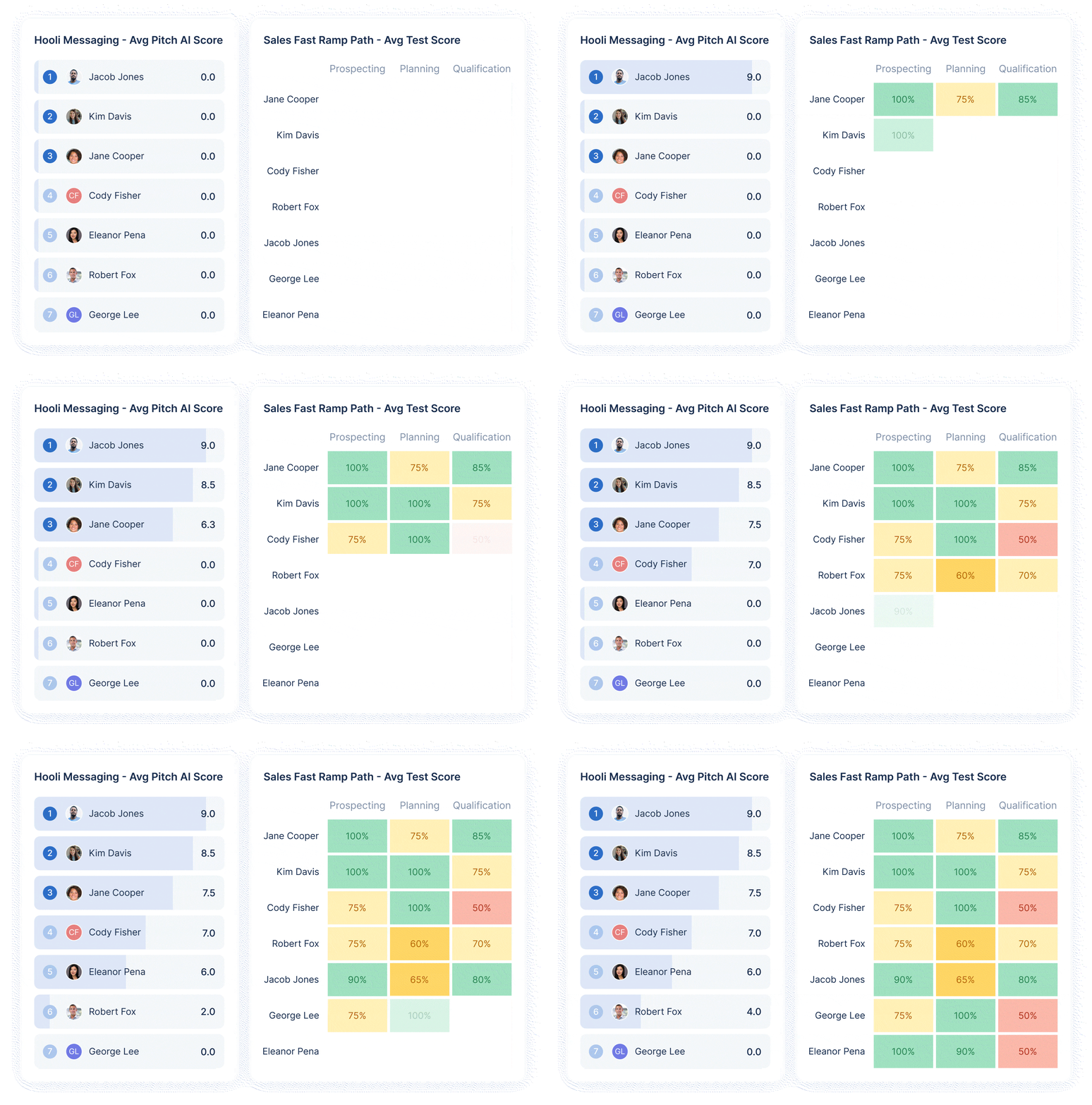
- Knowledge Retention Scores: Use assessments to gauge reps’ understanding and application of enablement training.
- Behavioral Changes: Observe whether reps adopt best practices and apply skills learned during training.
6. Customer-Centric Metrics
- Customer Satisfaction (CSAT) Scores: Measure how well sales reps meet customer needs, indicating the alignment between enablement and buyer experience.
- Customer Retention Rates: Evaluate whether improved sales alignment results in stronger long-term customer relationships.
7. Performance Insights
- Leverage analytics platforms to gain insights into the correlation between enablement initiatives and sales outcomes. Platforms like SalesHood can provide granular data on training completion, content engagement, and deal progression tied directly to enablement activities.
By focusing on these metrics, organizations can clearly link sales enablement initiatives to tangible business outcomes, demonstrating ROI and identifying areas for improvement.
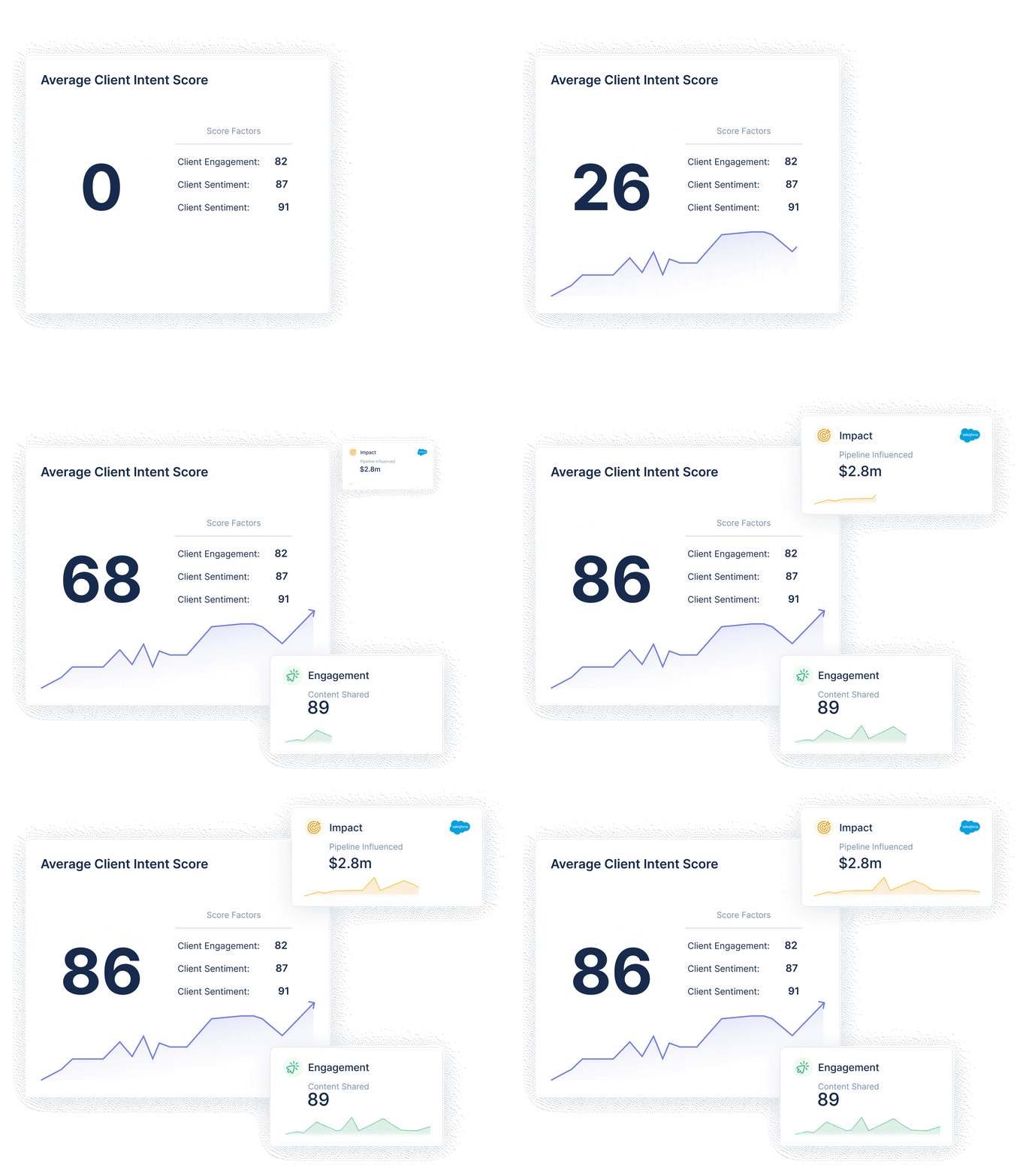
Both leading and lagging indicators matter. Activities like emails, calls, meetings scheduled, and pipeline created are strong leading indicators to measure and coach against. With SalesHood’s Impact Insights, you can track leading vs lagging indicators and run correlation reports that visualize the impact of enablement on revenue.
Sales Enablement Use Cases and Case Studies
Sales enablement is not just a concept. Here are real examples of how companies use SalesHood to streamline execution, improve efficiency, and grow revenue.
1. Doubling Selling Price and Shortening Sales Cycles: StarComplianceStarCompliance implemented SalesHood’s platform to transform their sales training and coaching processes. By aligning their teams on consistent messaging and empowering them with tailored enablement resources, they achieved:
2. Scaling Training, Onboarding, and Messaging Alignment: CopadoCopado, a leader in DevOps for Salesforce, utilized SalesHood to unify their global go-to-market teams. With tools for collaborative learning, process consistency, and content management, they saw:
3. Improving Lead Conversion with Digital Sales Rooms Companies integrating SalesHood’s Digital Sales Rooms to enhance buyer engagement and accelerate decision-making are realizing a 60% increase in lead-to-opportunity conversion, driven by personalized experiences and seamless communication with potential buyers. 4. Accelerating Onboarding for New Hires Sales enablement platforms streamline the onboarding process by delivering interactive learning experiences. For example, a SalesHood customer reduced onboarding times by over 30%, enabling new hires to contribute to pipeline and quota faster. With just-in-time learning and GenAI Coaches, new sales reps build confidence and competence more quickly. 5. Driving Buyer Engagement Through Digital Sales Rooms Digital Sales Rooms (DSRs) like those offered by SalesHood provide a centralized hub for collaboration between buyers and sellers. DataEndure leveraged DSRs to offer personalized content and facilitate seamless communication, resulting in a 60% improvement in lead-to-opportunity conversion rates. 6. Enabling Solution Selling in Complex B2B SalesMany of SalesHood’s customers utilize its tools to train sales reps on value-based selling techniques, crucial in long sales cycles involving multiple stakeholders. The platform empowers sellers with curated content and real-time coaching, boosting win rates in competitive scenarios. Mutual Action Plans (MAPs) keep sellers and buyers aligned throughout the process, improving transparency and accelerating decisions. SalesHood’s performance insights help managers track adherence to sales methodologies like MEDDICC, enabling data-driven forecasting and early risk identification. 7. Providing Sales Teams with Contextual ContentSales enablement helps teams access the right content at the right time. One software company used SalesHood to deliver tailored pitch decks and case studies to salespeople within seconds, enabling them to respond to prospect needs more effectively and close deals faster. Advanced AI now personalizes content recommendations based on buyer behavior, turning every interaction into a trust-building opportunity. 8. Enhancing Partner EnablementCompanies with channel or reseller networks use enablement tools to train and certify partners. SalesHood gives partners the tools, content, and training to sell effectively. AI-driven insights, adaptive learning, and easy resource access keep partners current on products and best practices, while embedded analytics let businesses track partner performance and provide targeted support. |
SalesHood offers functionality to create partner-specific resources, ensuring channel sellers are well-equipped to represent the brand and close deals.
Sales Enablement vs. Revenue Enablement: What’s the Difference?
|
Sales Enablement |
Revenue Enablement |
|
|
Focus |
The sales team specifically |
All customer-facing go-to-market functions, including marketing, customer success, sales engineering, product, and partners |
|
Primary goal |
Help salespeople engage buyers, overcome objections, and close deals more consistently |
Create a unified buyer experience across the full customer lifecycle |
|
Core programs |
Onboarding, messaging alignment, playbooks, and real-time deal support |
Shared metrics, integrated content strategies, and cross-functional collaboration |
|
Lifecycle coverage |
Focused on the acquisition stage |
Covers acquisition, onboarding, adoption, expansion, and renewal |
|
Performance view |
Individual and team sales performance |
Revenue outcomes across all go-to-market roles |
Sales enablement focuses on helping sales teams sell more effectively. It provides sellers with the tools, content, training, and coaching they need to engage buyers, overcome objections, and close deals. Traditional sales enablement programs prioritize onboarding, messaging alignment, playbooks, and real-time deal support. The core mission is to boost individual and team performance, making the sales process more consistent and productive.
Revenue enablement, by contrast, takes a broader and more strategic view. Instead of focusing solely on the sales team, it aligns all go-to-market functions—marketing, customer success, sales engineering, product, and even partners—to create a unified buyer experience. Revenue enablement supports the full customer lifecycle: from acquisition to onboarding, adoption, expansion, and renewal. It leverages shared metrics, integrated content strategies, and cross-functional collaboration to maximize long-term customer value.
|
In short: Sales enablement empowers sales teams to close deals. Revenue enablement aligns all revenue teams to drive growth and retention. |
As organizations shift toward buyer-centric, recurring-revenue models, revenue enablement reflects the next evolution of enablement strategy.
How Does Sales Enablement Differ From Sales Operations?
Sales operations manages the systems and structures that support selling—think: quotas, territories, tech stacks, pipeline analytics, compensation plans, and process design. It’s a function built to optimize efficiency and execution.
Sales enablement, meanwhile, exists to empower people. It equips reps with the knowledge, content, and coaching they need to deliver compelling buyer experiences. Where sales ops focuses on internal mechanics, sales enablement bridges the gap between buyer needs and sales execution—helping reps speak the right language at the right time.
Quick comparison:
Sales Ops = Operational efficiency (systems, data, processes).
Sales Enablement = Human effectiveness (training, messaging, buyer engagement).
The difference is subtle but powerful. Sales enablement helps salespeople connect with real humans—buyers—with confidence and clarity.
The Revenue Enablement Maturity Model: A Roadmap for Growth
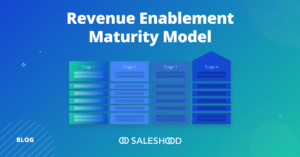
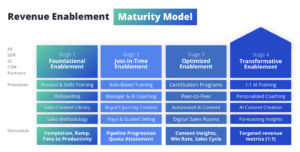
As revenue enablement becomes a strategic priority, teams need a clear path to evolve. That’s where the SalesHood Revenue Enablement Maturity Model comes in. Based on years of working with top-performing go-to-market teams, this model provides a step-by-step framework for scaling enablement programs—from foundational execution to enterprise-wide transformation.
The model outlines four stages of maturity, each building on the last. At every stage, teams strengthen alignment, improve process consistency, and expand impact across the entire customer journey. Whether you’re just getting started or looking to scale, this framework offers a proven path to driving measurable revenue outcomes.
 |
How Is AI Changing Sales Enablement?
AI capabilities help revenue teams execute a more efficient and effective customer journey. Across every component of modern enablement, from onboarding and readiness to content creation, coaching, and prospect engagement, AI is driving faster ramp times, conversational confidence, and consistent messaging.
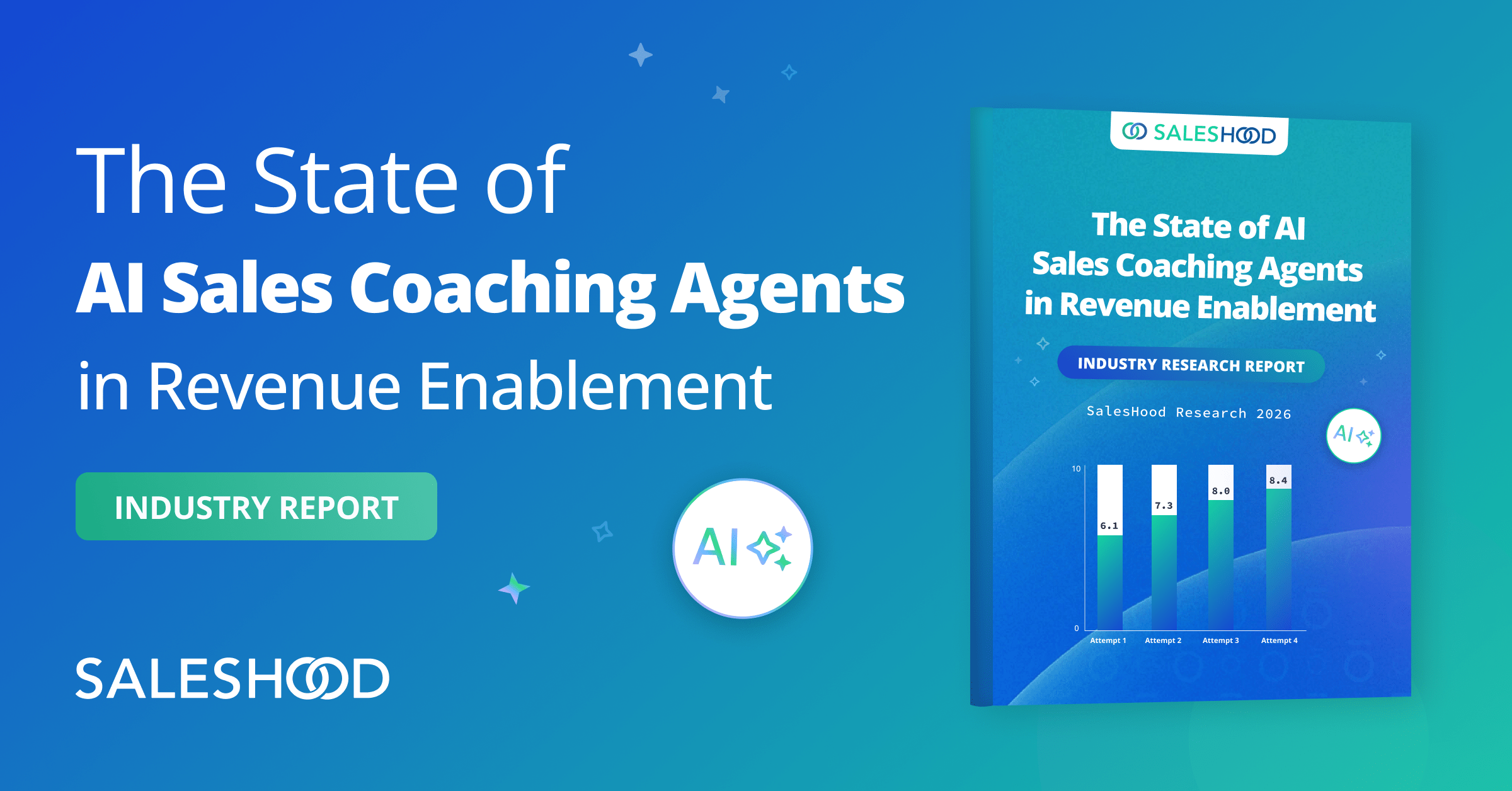
The scale of the shift is visible in SalesHood’s State of AI Sales Coaching in Revenue Enablement 2026, which analyzed 34,922 coaching submissions. Teams running AI coaching programs are:
- Launching programs 3x faster
- Seeing a 45% increase in participation
- Improving seller skills by up to 38% after four practice sessions
- Reducing time to readiness by 40%
- Saving managers an average of 24 hours per month
- Increasing pipeline conversion rates up to 5x
On the readiness front, AI certifies salespeople faster and gets them conversationally competent, regardless of location. For content, AI assists in creating, downloading, and curating material to make it easily accessible to sales teams. When salespeople engage prospects, AI automatically creates call recaps, helps them present themselves consistently, and adds descriptions to shared content.
AI is becoming critical as enablement teams shrink and are expected to do more with less. Features like AI Coach allow companies to rely on AI for certifying and coaching salespeople. Without AI, many overwhelmed enablement teams will fall behind.
AI Coaching at Copado
The key question Copado faced was how to use AI to be more efficient and deliver what their field needs when they need it. They wanted to move from passive learning, such as watching videos and reviewing slide decks, to active participation where reps could practice skills and get instant feedback.
With SalesHood’s AI Coach, Copado’s reps can now practice and get feedback in minutes, rather than waiting days for manager input. This has fundamentally shifted their approach to enablement, allowing for smaller, bite-sized learning spread out over time. Reps find it easier to consume and actively engage, instead of just reading or zoning out during a video.
By doing active learning much earlier in the process, Copado’s reps get better at their skills sooner, leading to increased efficiency. A prime example of this was preparing for Dreamforce. Copado had seasoned product people, sales reps, and SDRs with varying levels of experience all conversation-ready. Watch the short two highlights video or click to watch the full interview.
The Future of Artificial General Intelligence (AGI) and Sales Enablement
The future of sales enablement lies in blending human ingenuity with advanced technology, particularly Artificial General Intelligence (AGI), to create a more effective, scalable, and insightful sales ecosystem. Four shifts are already taking shape.
1. AI-Driven Personalization at Scale
AGI enables a deeper understanding of individual sales reps’ strengths, challenges, and learning styles. With SalesHood’s solutions, this could translate into tailored coaching programs, just-in-time content recommendations, and automated feedback loops that adapt dynamically to each salesperson’s needs.
2. Seamless Buyer-Seller Alignment
SalesHood’s Mutual Action Plans (MAPs) already drive alignment, but AGI will enhance this by predicting and addressing potential friction points in the buyer journey. It will act as a proactive partner, guiding sales teams to foster stronger, trust-based relationships with buyers.
3. Predictive Sales Insights
AGI takes performance insights to a new level by analyzing complex datasets across customer interactions, sales behaviors, and market trends. It helps organizations predict deal outcomes, identify revenue opportunities, and allocate resources more effectively.
4.Automated Content Activation
AGI can transform how sales teams interact with content. Instead of searching for materials, sales reps will receive real-time recommendations based on buyer behavior, engagement signals, and deal context, ensuring the right message is delivered at the perfect moment.
5. Continuous AGI-Powered Coaching
AGI coaches will evolve into highly intuitive partners that train, mentor, and provide emotional intelligence support. These coaches simulate real-world selling scenarios, giving salespeople hands-on practice and instant, actionable feedback.
Taken together, these shifts position AGI as a co-pilot for sales teams, helping them close deals faster, deliver predictable revenue outcomes, and foster long-term customer relationships. It is not about automating tasks. It is about giving salespeople more space to do what they do best, build connections and deliver value.
.
6. Enhanced Collaboration Between Sales and Marketing
AGI will bridge gaps between sales and marketing by analyzing the performance of sales content in unprecedented detail. This ensures that every piece of content created delivers measurable impact, fostering alignment across go-to-market teams.
7. Scalable Sales Execution
With AGI, SalesHood will enable companies to replicate top-performing behaviors across their entire organization. AGI will analyze patterns from high-performing reps, democratize best practices, and ensure consistency in execution across teams and regions.
SalesHood’s vision embraces AGI as a co-pilot for sales teams, enabling them to close deals faster, deliver predictable revenue outcomes, and foster long-term customer relationships. It’s not just about automating tasks; it’s about empowering salespeople to focus on what they do best—building connections and delivering value—while AGI handles the rest.
How Should You Structure Your Sales Enablement Team?
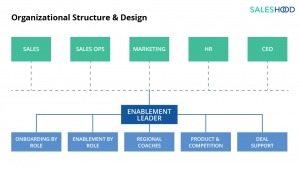
A well-structured sales enablement team is the difference between a program that scales and a program that stalls. Six practices show up in every high-performing team:
- Define clear roles and responsibilities. Each team member owns a distinct area, whether onboarding, coaching, content, or technology.
- Maintain an optimal team ratio. Aim for one enablement professional per 10 to 15 salespeople to deliver meaningful impact without overextending the team.
- Balance strategy, content, and technology. Equip the team to drive high-level initiatives, develop impactful content, and manage the platform effectively.
- Promote cross-functional alignment. Foster tight collaboration between sales, marketing, product, and customer success.
- Use automation and AI to scale. Streamline repetitive tasks, personalize coaching, and surface the right content at the right time.
- Measure what matters. Track ramp time, win rates, and content usage to continuously optimize.
Here’s an image of a sample sales enablement organizational chart:
Read: Sales Enablement Organizational Structure: Ownership, Reporting, and Ratios
Why Marketing Should Care About Sales Enablement
CMOs and product marketers should care about sales enablement because it aligns marketing efforts with sales outcomes, ensuring that marketing’s contributions drive tangible revenue impact. Sales enablement provides the tools, training, and resources sales teams need to engage buyers effectively, close deals faster, and maintain consistent messaging across the buyer journey. It acts as the bridge between marketing creativity and sales execution, enhancing the ROI of marketing efforts by making them actionable and effective for sales teams.
Where Sales Enablement Goes from Here
We are at a point where every revenue team has more tools, more content, and more dashboards than ever before, and most are still not hitting quota. The teams that change that trajectory will not be the ones with the biggest tech stack. They will be the ones that treat enablement as a daily, measurable, AI-assisted execution system rather than an annual investment in training.
SalesHood’s Agentic AI Sales Enablement Platform was built for this shift. It unifies content, learning, coaching, and buyer engagement so revenue teams stop toggling between disconnected tools and start running enablement as one continuous loop tied directly to revenue outcomes. If your team is investing in enablement and still missing quota, the gap is almost always execution, and that is exactly what SalesHood is built to close.
Beware of checkbox enablement. With the explosive growth of the category, many platforms were built around completing certifications and ticking boxes rather than building real skills. For sales enablement to work, salespeople need to engage and learn from each other consistently, ideally daily. A platform that does not drive interaction, modeling, and practice will not move the numbers.
Want to see what enablement looks like when it is built around execution?
Book a demo with SalesHood and we will walk you through how teams like Copado, StarCompliance, and SmartRecruiters are using the platform today.
Frequently Asked Questions (FAQs)
What is sales enablement in simple terms?
Sales enablement is the discipline of giving salespeople the content, training, coaching, and tools they need to engage buyers and close deals consistently. It connects go-to-market strategy to frontline execution, so the way the company sells matches the way it says it sells.
What does a sales enablement team do?
A sales enablement team owns the systems and programs that make salespeople ready and effective. That typically includes onboarding, ongoing training, coaching, content management, sales methodology adoption, and measurement of how all of it impacts revenue. The team works closely with sales leadership, marketing, product, and customer success.
What are the main benefits of sales enablement?
The strongest benefits are faster ramp time for new hires, more consistent messaging across the team, higher win rates, shorter sales cycles, better content effectiveness, and improved manager coaching capacity. The best programs measure these outcomes directly rather than tracking activity completion.
What is the difference between sales enablement and sales training?
Sales training is typically event-based: a workshop, a kickoff, and a certification. Sales enablement is continuous. It includes training, but also content, coaching, practice, and measurement, all delivered in the flow of work. Training is a part of enablement, not a substitute for it.