Key takeaways
- Coaching is a revenue system, not a soft skill. SalesHood customers report 200% win rate improvements when coaching is embedded in the daily workflow of go-to-market teams.
- Manager time is the real bottleneck. AI-powered coaching returns up to 24 hours a month to frontline managers, redirecting them toward strategic deal reviews and high value team development activities.
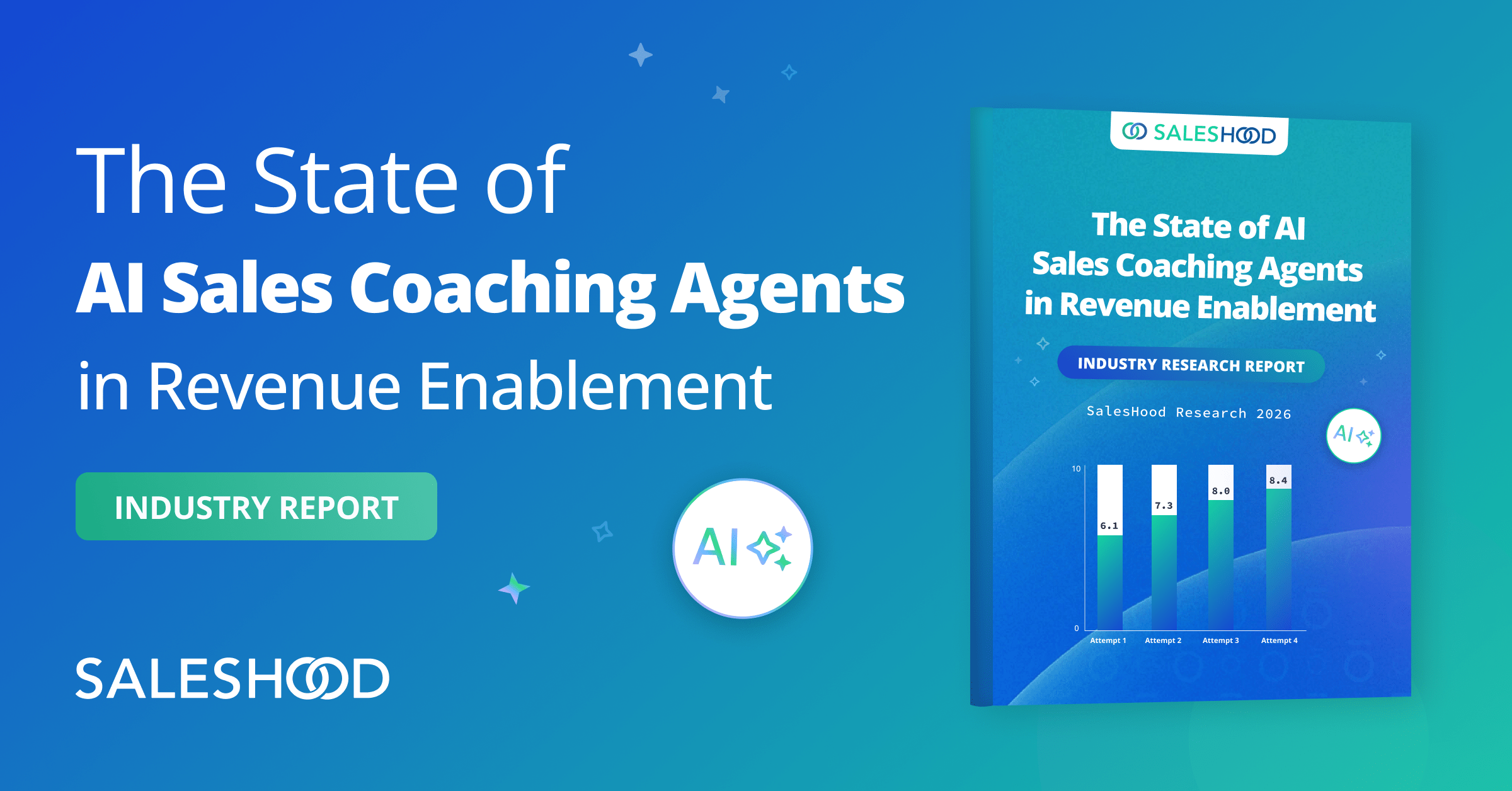
- Practice frequency beats practice volume. High-performing teams average seven AI role-play sessions per person per month and see 38% skill improvement across four attempts.
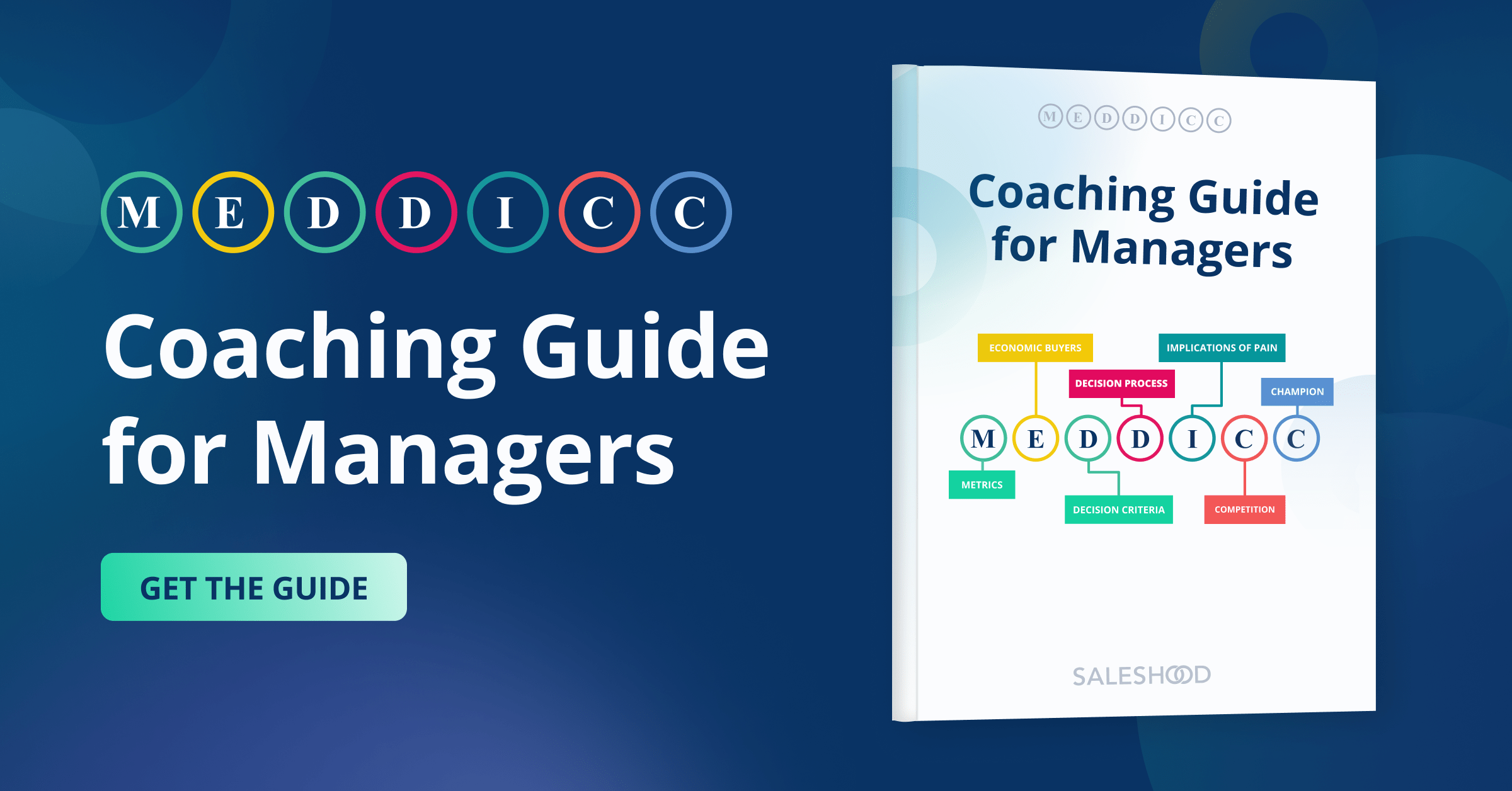
- Structured frameworks beat open-ended conversations. MEDDPICC coaching shifts salespeople from feature-led pitches to consultative selling, improves qualification execution and helps sellers stop spending time on deals that will never close.
I’ve worked with thousands of sales managers over the years, and almost all of them say the same thing: they want to coach their teams more. They really do. The intent is there. The belief is there. But in reality, it rarely happens and when it does, it’s rushed, out of context, and doesn’t actually change how reps sell.
The problem isn’t that managers don’t care about coaching. It’s that coaching keeps losing to everything else on their calendar. Pipeline reviews, forecast calls, deal escalation, internal meetings which always come first. Coaching gets whatever time is left over, which usually means it gets rushed or skipped altogether.
When coaching does happen, it often doesn’t look like coaching. It turns into a deal review or a status update. Managers ask for updates, sellers walk through their pipeline, and the conversation moves on. No specific skill is addressed. No behavior is corrected. Nothing actually improves. It feels productive in the moment, but it doesn’t change how the next call goes.
That’s why most coaching programs don’t move the needle. They’re built around meetings, not around behavior change. And if coaching only shows up as a recurring 1:1 on the calendar, it will always be inconsistent, reactive, and disconnected from the moments that actually matter in a deal.
Most sales coaching programs don’t fail because of bad intent. They fail because nothing actually changes. I’ve sat in hundreds of pipeline reviews where a manager says: “We just need to coach more.” And then the next week performance is the still same. Salespeople still:
- Pitch too early
- Don’t really understand the customer’s top problems
- Lack building a shared mutual action plan
- Leave calls without clear next steps
The issue isn’t that teams don’t believe in coaching. The issue is this:
Managers want to coach but the coaching never happens and when it happens it’s ineffective ad out of context. on the calendar instead of inside the workflow.
And when that happens, it loses every time to:
- Pipeline pressure
- Deal firefighting
- Forecast calls
So it gets skipped or rushed or Or turns into a status update. The teams that actually improve performance do one thing differently:
They stop treating coaching like a meeting and start treating it like a system.
That shift changes everything. Reps practice more. Managers coach better. Deals move faster
This guide is about how to build a living and breathing coaching system that actually works. Find out what’s working, what’s not working and what most teams are getting wrong.
What is sales coaching and why it matters today
Sales coaching is the process of helping salespeople improve how they actually sell in real deals, with real buyers, under real pressure. That sounds obvious, but most teams get this wrong. They confuse coaching with training. Training is onboarding, product knowledge, and messaging rollouts. It’s necessary but it doesn’t change behavior.
Coaching is what happens after the training when a rep is on a call with a skeptical CFO, trying to move a stalled deal, or figuring out why a “good” opportunity isn’t progressing. That’s where deals are won or lost. The gap between training and execution is where most revenue teams struggle.
You can roll out the perfect pitch, certify every rep, and run a strong kickoff and still hear calls where reps lead with features, avoid hard questions, and miss the real decision process. Not because they don’t know better, but because no one is coaching them in the moments that matter.
That execution gap is getting wider. Buyers are more complex more stakeholders, longer cycles, higher scrutiny. At the same time, consistency is breaking down. Marketing says one thing, the website says another, and the rep says something different. That disconnect kills trust and it kills deals.
Coaching is the only mechanism that closes that gap. It’s what ensures your strategy shows up in conversations, your messaging is delivered consistently, and your reps know how to handle real situations—not just ideal ones.
And when it works, the impact is clear: faster ramp, better deal execution, and higher win rates.
Sales training vs. sales coaching: a quick reference
|
Dimension |
Sales Training |
Sales Coaching |
|---|---|---|
|
Goal |
Transfer knowledge, onboard new reps, introduce a new product or playbook |
Change behavior in real deals, sharpen skill execution, improve win rates |
|
Cadence |
Episodic. Kickoffs, onboarding cohorts, quarterly enablement events |
Continuous. Weekly 1:1s plus daily AI-powered practice |
|
Format |
Lectures, LMS modules, workshops, slide decks |
1:1 feedback, role-play, deal reviews, AI coaching agents |
|
Measured by |
Completion rates, certification scores, attendance |
Skill improvement, pipeline conversion, time to readiness, win rate lift |
|
Who owns it |
Enablement team |
Frontline managers, supported by enablement and AI |
Core elements of an effective sales coaching program
If coaching isn’t working on your team, it’s usually not because people don’t care. It’s because a few critical pieces are missing. Most organizations approach coaching with good intent but no system. They add more meetings, more sessions, more expectations but nothing actually changes. Sales teams still struggle in the same moments, and managers default back to deal inspection instead of skill development.
The teams that get this right don’t rely on effort. They design coaching as a system that consistently improves how reps sell. That system has a few core elements.
Goal setting and sales coaching metrics
If you don’t define what coaching is supposed to change, it won’t change anything. Most teams measure activity including sessions completed, attendance, and certifications. Unfortunately, none of that tells you if coaching is actually working.
When looking at measuring the effectiveness of a sales coaching initiative, it’s best to start with a simple question: What revenue outcome should this program move?
Effective coaching programs measure two things at the same time. Leading indicators tell you if coaching is happening. Are reps practicing consistently? Are they improving specific skills? Is participation high across the team? If those aren’t moving, nothing else will. Lagging indicators tell you if coaching is working. Win rates, pipeline conversion, deal velocity, time to ramp. That’s where coaching proves its value.
The mistake is focusing on one without the other. If you only look at lagging indicators, you’re reacting too late. If you only look at leading indicators, you’re just tracking activity. You need both, and you need to review them consistently. If coaching doesn’t show up in your revenue numbers, it’s not a program—it’s a checkbox. Learn more about leading and lagging indicators.

Structured 1:1 coaching sessions
Cadence matters, but structure matters more. Most 1:1s are labeled as coaching, but they’re really pipeline reviews. Reps walk through deals, managers react, and the conversation ends with no clear skill improvement. It feels productive, but it doesn’t change behavior. Effective coaching sessions are focused and intentional. The best managers anchor every 1:1 around one deal and one skill. That constraint forces the conversation to go deeper instead of spreading across multiple topics.
A strong coaching conversation starts with what’s actually happening in the deal. Where is it stuck? Where is it at risk? Then it isolates the skill gap behind that moment including discovery, positioning, qualification, or closing.
From there, the conversation shifts from “what’s happening” to “how do we improve how you’re selling in this situation.” Every session should end with clear commitments. Not general advice, but specific actions the rep will take before the next interaction.
When this works, 1:1s stop being status updates and start becoming skill-building sessions that directly impact deal outcomes.
Real-time feedback and call coaching
Speed matters more than volume when it comes to coaching.
The traditional model—reviewing calls days later and giving general feedback—is too slow. By the time feedback is delivered, the rep has already had multiple similar conversations and repeated the same mistakes.
That doesn’t drive improvement.
Effective coaching happens close to the moment and focuses on specifics.
Instead of broad feedback like “you need to improve your messaging,” it focuses on a precise moment in the conversation. Where did the buyer disengage? Where did the rep lose clarity? Where did the next step break down?
That level of specificity makes coaching actionable.
When feedback is tied to real moments in real calls, managers are no longer coaching from memory or opinion. They’re coaching against what actually happened. That shift alone dramatically improves how quickly reps develop.
Across repeated practice and feedback cycles, small corrections compound into meaningful performance gains.
Enabling managers to coach effectively
A coaching program is only as strong as the managers running it.
Most organizations under-invest here. Managers are promoted because they were strong sellers, but they’re rarely trained on how to coach. As a result, they default to what’s comfortable, giving advice, sharing their own experiences, or stepping in to fix deals.
That approach doesn’t scale and doesn’t build capability across the team.
Effective managers coach differently.
They coach against a framework, not their opinion, so every rep is evaluated against the same criteria. This creates consistency across the organization and removes ambiguity from coaching conversations.
They push reps to speak in the customer’s language, not product language. Instead of focusing on what was presented, they focus on what the customer actually said, what matters to them, and what happens if they don’t act.
They make reps own the deal. Managers ask questions and guide thinking, but reps are responsible for the answers. That dynamic builds accountability and develops stronger sellers over time. They also extend coaching beyond 1:1s. Team-based deal reviews and peer visibility raise the standard across the entire group in a way that private conversations cannot. When managers operate this way, coaching becomes consistent, scalable, and directly tied to performance.
When these elements are in place, coaching becomes part of how the team operates. It’s consistent, relevant, and tied to real deals. When they’re missing, coaching becomes what it is for most teams—sporadic, reactive, and disconnected from the moments that actually matter. That’s the difference between a coaching program that exists and one that actually drives revenue.
Modern sales coaching approaches and trends
Sales coaching hasn’t failed because the idea is wrong. It’s failed because the way most teams try to do it doesn’t work anymore. The traditional model with scheduled 1:1s, occasional call reviews, manager-driven feedback, was built for a different environment. Smaller teams, simpler deals, fewer stakeholders.
That’s not the reality today.
Deals are more complex. Buyers are more informed. Sales cycles are longer. And managers are stretched thinner than ever. So coaching has to evolve. The teams that are actually improving performance aren’t just “doing more coaching.” They’re changing how coaching works in a few fundamental ways.
From scheduled coaching to continuous coaching
Most coaching still lives on the calendar. A weekly 1:1. Maybe a deal review. Sometimes a call debrief. The problem is that deals don’t move on a schedule. Sales teams need help before a call, during a deal, and immediately after key moments, not days later in a scheduled meeting.
High-performing teams treat coaching as continuous. Salespeople are practicing regularly, reviewing key moments in near real time, and improving between live conversations, not just during them. That shift changes the impact of coaching. Instead of reacting to problems, teams start preventing them.
From manager-dependent to system-supported
In most organizations, sales coaching quality depends entirely on the manager. Some managers are great coaches. Most are inconsistent. And even the best ones don’t have enough time to scale. That creates uneven performance across the team. Some salespeople improve quickly. Others stall.
Modern coaching systems reduce that dependency. They create structure around how coaching happens, what gets practiced, and how feedback is delivered. They make expectations clear, not subjective. They give managers a consistent way to coach and reps a consistent way to improve.
The goal isn’t to remove the manager. It’s to remove the variability.
When coaching is system-supported, it becomes repeatable across teams not just dependent on individual managers.
From generic feedback to deal-specific coaching
Most coaching advice is too general to be useful.
“Be more consultative.”
“Ask better questions.”
“Focus on value.”
Sellers hear this all the time, but it doesn’t change what they do on their next call. Effective coaching is tied to real situations.
It focuses on specific moments in specific deals. Where did the conversation break down? Where did the buyer disengage? What was missed in discovery? Why didn’t the next step land? That level of specificity turns coaching into something actionable.
Instead of abstract advice, reps get clear direction they can apply immediately. Over time, those small corrections compound into much stronger deal execution.
The role of frameworks in modern coaching
One of the biggest reasons coaching feels inconsistent is that every manager coaches differently. That creates conflicting advice, shifting expectations, and a lack of trust in the process. Frameworks solve that.
A framework like MEDDPICC doesn’t just help qualify deals, it gives managers a shared way to diagnose what’s actually happening. Instead of relying on instinct, coaching becomes grounded in clear signals.
- Do we have a real champion?
- Do we understand the decision process?
- Is there actual urgency, or just interest?
Now coaching is no longer “I think this deal looks good.” It becomes “we’re missing the economic buyer, this deal is at risk.”
That clarity is what changes behavior. We invite you to download our MEDDICC Coaching Guide for managers.
Modern sales coaching isn’t about adding more sessions or more tools. It’s about changing how coaching actually happens.
From scheduled to continuous.
From manager-dependent to system-supported.
From generic to deal-specific.
Teams that make those shifts see coaching show up where it matters—in how reps execute in real deals. Teams that don’t keep doing what they’ve always done—and get the same results.
AI-powered and data-driven sales coaching
Every coaching program eventually hits the same wall: Managers don’t have the time to coach every one of their sales team members, on every skill, in every deal. That’s the real constraint. There just isn’t enough time in a day to get it all done.
At a small scale, managers can stay close to every conversation. They can run role-plays, review calls, and give detailed feedback. But as teams grow, that breaks. Coaching becomes selective. The loudest deals get attention. The rest get ignored. That’s not a coaching strategy, it’s a capacity problem. This is where AI starts to matter. This is where AI coaching will help.
AI doesn’t replace coaching, but it removes the bottleneck around practice and feedback.
The biggest shift is around practice. In most teams, sellers don’t practice enough because it requires manager time. Role-plays have to be scheduled. Feedback is delayed. And over time, practice becomes inconsistent or disappears altogether. AI changes that.
Sellers will practice on demand, before a call, after a call, or when a deal is stuck. They can run through the same scenario multiple times, get immediate feedback, and improve before they ever get in front of a customer. That’s a fundamentally different model. Instead of learning in live deals, reps are improving ahead of them.
The second shift is speed of feedback. In the traditional model, feedback comes too late. A call happens, maybe it gets reviewed days later, and by then the seller has already repeated the same mistake multiple times. With AI, that loop compresses. Sellers get immediate insight into what worked and what didn’t, where they lost clarity, where the buyer disengaged and where the next step broke down. That feedback loop—practice, feedback, repeat—is what actually drives improvement.
But this is where most teams get it wrong. They treat AI like a replacement for coaching instead of an extension of it. AI is not there to coach strategy, judgment, or deal navigation. It’s there to handle repetition and pattern recognition at scale. The manager’s role becomes more focused, not less.
Instead of spending time running basic drills, managers can focus on high-leverage moments, complex deals, critical conversations, and the areas where judgment matters most. That’s where coaching actually drives impact. The model shifts from manager-only coaching to a combination of system and human. AI handles the volume. Managers handle the nuance. When that balance is right, coaching becomes continuous, scalable, and directly tied to how deals move.

Virtual sales coaching for remote teams
Remote and hybrid teams changed the coaching equation more than most leaders expected. In an office, coaching happens naturally. Managers overhear calls. Sellers ask quick questions. Feedback happens in the moment. That disappears in a distributed environment.
Now coaching has to be intentional. And most teams underestimate how big that shift is. The default response is to add more meetings—more Zoom calls, more check-ins, more scheduled coaching sessions. That usually makes things worse.
Synchronous time is limited, and when managers spend it running basic pitch practice or reviewing surface-level updates, they lose the opportunity to focus on real deal coaching.
That’s a bad trade.
The teams that make remote coaching work do two things differently. First, they shift practice out of live sessions.
Sellers record their pitches, objection handling, and deal walkthroughs on their own time. That creates a safe space for repetition without requiring manager availability. Second, they make coaching visible.
Video changes the dynamic. When a rep records themselves explaining a deal or delivering a pitch, it’s immediately clear whether they actually understand what they’re saying. You can’t hide behind slides or a written update.
That visibility matters not just for managers, but for peers. When teams share recordings and feedback openly, standards rise quickly. Reps learn from each other, not just from their manager. This is where remote teams can actually outperform in-person teams. When practice is asynchronous and feedback is continuous, coaching becomes more scalable, not less. Managers spend less time coordinating and more time focusing on high-impact moments.
Sellers practice more often and improve faster. And coaching becomes part of the workflow, instead of something that depends on being in the same room.
Actionable sales coaching strategies for managers
At the end of the day, coaching doesn’t happen because of frameworks or tools. It happens because managers build it into how their team operates. The difference between teams that talk about coaching and teams that actually coach comes down to a few consistent habits.
Pre-call planning and post-call reviews
The most effective coaching doesn’t start after the call. It starts before it. Most reps go into important conversations underprepared. They know the product, but they haven’t thought through how the conversation should unfold. That’s where managers should focus. Before a call, the goal is simple: get the rep clear on what they’re trying to achieve. A simple structure works.
The AAA Plan, created by Dan Dal Degan, gives revenue teams a 15-minute game plan for every meeting that matters.
- Answers. What open-ended questions will surface the buyer’s real priorities? Not “Is ROI important?” but “How are you thinking about ROI this quarter?”
- Attitudes. What belief must the buyer hold by the end of the meeting? Example: “This partner is the safest choice for our team.”
- Actions. What specific, tangible commitment will the rep ask for at the close? A contract review, a reference call, a CFO meeting. One clear ask beats five vague ones.
Post-call, the debrief is not “how did it go?” It is four questions, and the rep must answer in the customer’s own language, not the rep’s.
- What did the customer actually say?
- Why is that important to the customer?
- What happens if the customer does nothing?
- What are the specific next steps to move this deal forward?
If the sellers cannot answer those four questions in the customer’s own words, the deal is less qualified than the pipeline says.
Role-playing and peer-to-peer coaching
Most teams treat role-play as a one-time exercise. Something you do before a big meeting or during onboarding. That’s not enough. Selling is a skill. And like any skill, it requires repetition. High-performing teams build practice into the weekly rhythm. Reps are constantly refining how they open conversations, handle objections, and position value.
But the real unlock isn’t just practice, it’s peer visibility.
When sellers review each other’s pitches and deal walkthroughs, the standard rises quickly. People see what good looks like. They see where others struggle. And they adjust faster than they would in isolation. Managers don’t have to carry the full coaching load. The team starts to coach itself.
Building a strong coaching culture
Coaching doesn’t scale because of process alone. It scales because of culture. And culture is set at the top. If coaching feels optional, it will be ignored. If it feels like extra work, it won’t stick. The teams that get this right make coaching part of the job, not something separate from it.
That starts with leadership behavior.
When leaders record their own pitches, share their own deal reviews, and ask for feedback, it changes how the team sees coaching. It stops being something you’re evaluated on and starts being something you participate in.
That shift matters. Because once coaching becomes visible and consistent, it becomes part of how the team improves—not just something that happens in isolated moments.
Common sales coaching mistakes to avoid
Most sales coaching programs do not fail because the content is wrong. They fail because a handful of predictable mistakes quietly undermine the whole system. These are the six that come up most often, with what to do instead.
|
Mistake |
Why It Fails |
What to Do Instead |
|---|---|---|
|
Confusing coaching with status updates |
Weekly 1:1s become pipeline reviews. Reps report numbers and leave without a single skill improvement. |
Structure every 1:1 around one deal and one skill. End with two or three specific actions the rep owns. |
|
Coaching without a framework |
Feedback swings from manager to manager. Reps hear contradictory advice and lose trust in the process. |
Anchor coaching to a single deal methodology like MEDDPICC so every manager coaches against the same criteria. |
|
No feedback loop after the call |
Reps move on to the next call before the last one is debriefed. Mistakes repeat. |
Use AI call intelligence to surface missed moments within hours, not weeks. Debrief against the customer’s own words. |
|
Generic, one-size-fits-all coaching |
Top performers get bored. New reps drown. Neither improves. |
Personalize practice paths. AI role-play adapts scenarios to rep tenure, role, and skill gap. |
|
Executives sit on the sideline |
When leaders do not record their own pitches, the team treats coaching as optional. |
CROs and VPs go first. They certify before their reps do. Culture follows behavior. |
|
Measuring activity, not outcomes |
Teams track number of coaching sessions instead of skill lift, win rate, or pipeline conversion. |
Report on leading indicators (practice cadence, participation) and lagging indicators (win rate, ramp time) together. |
The common thread across all six mistakes is the same: treating coaching as an event instead of a system. Programs that survive are engineered for cadence, framework consistency, and executive modeling. Everything else is optional.
Measuring the impact of sales coaching
Sales coaching is no longer a soft HR metric. It is a measurable revenue driver, and modern revenue teams measure it like one.
The shift starts with what gets tracked. Dashboards built around leading indicators tell leaders far more than lagging quota numbers alone. SalesHood’s Impact Insights frame this in three dimensions:
- Performance Leaderboards show which reps are practicing and how consistently. This is the best predictor of future quota attainment.
- Content Effectiveness shows whether that practice is changing how reps engage buyers and which messaging actually influences deals.
- Pipeline and Revenue visibility ties it all together, giving leaders real-time confidence about what will close and where to intervene.
Then comes the hard ROI. When sales coaching is measured and continuously optimized through Agentic AI, the numbers are unambiguous: 45% lift in rep participation, 40% faster time to readiness, up to 5x improvement in pipeline conversion, and win rate gains from 25% to over 100%.
That is not a soft benefit. That is a business case.
Why sales coaching is a leadership imperative
A sales coaching program fails the moment it becomes a grassroots initiative. No amount of rep enthusiasm fixes a culture where leadership sits on the sideline.
The data on this is clear. Rep engagement and manager engagement are correlated. When a manager records their own pitch first, their team reaches quota faster. When the manager does not go first, social learning collapses. Collaboration drops. Peer review loses its energy. The whole system underperforms.
This is why executive participation is not optional. If a CRO or CEO expects the team to practice openly and share deal reviews honestly, they have to do it first. The moment leaders participate, coaching stops being a program. It becomes how the organization operates.
That shift is what separates a high-performance culture from a well-intentioned one.
Sales coaching tools and technology
Passive conversation intelligence, the first generation of tools that recorded calls and surfaced transcripts, was a starting point, not a finish line. Recording a call and hoping a manager finds time to review it is not a coaching strategy. It is a storage problem.
The modern revenue technology stack requires Agentic AI. Not AI that watches. AI that acts. Reps run role-plays with AI coaching agents before a discovery call, receive unbiased real-time feedback on tone, messaging, and keyword usage, and iterate before ever scheduling a live call with the buyer. That practice loop, repeated across four attempts, produces a 38% improvement in rep skills.
The right sales coaching platform unifies AI role-play with sales content management, digital sales rooms, and performance dashboards in one place. That unification is what reclaims the 20–25 hours a month managers currently spend on repetitive administrative coaching and redirects it toward strategic deal reviews.
SalesHood’s AI Coaching Agent, AI Content Agent, AI Deal Agent, and Digital Sales Rooms are built on five AI pillars: conversational, real-time, adaptive, a unified data model, and enterprise-grade AI data security. The result is a single system where sellers get the right answers, managers get the right insights, and buyers get the information they need to move forward confidently.
How to scale sales coaching across teams
What works for a 10-person sales team breaks at 100. At 1,000 distributed reps, it collapses. Scaling a sales coaching program is not a volume problem. It is a systems and culture problem.
The systems answer is asynchronous and AI-driven. Reps practice independently, receive AI-generated feedback, and iterate on their own schedule. No manager bottleneck. No time-zone dependency. High-performing enterprise teams average seven practice sessions a rep per month, with 85% participation. Infrastructure is what makes that consistency possible.
The culture answer starts at the top. When Bob Horn joined Cognitive Scale, he had every executive record their elevator pitch first. Then every product manager. Within days, the company had crowdsourced a new messaging standard and the entire organization was practicing together. That same principle holds at any scale. Executives go first. Managers follow. Teams certify faster and better because the standard is visible, not just described.
A six-stage coaching lifecycle makes the system repeatable as the team grows.
The sales coaching lifecycle
|
Stage |
Question It Answers |
Primary Action |
|---|---|---|
|
1. Assess |
Where are reps strong, and where are they stuck? |
Baseline skill assessments, call intelligence review, pipeline diagnostics. |
|
2. Plan |
What specific skill or deal behavior will we improve this quarter? |
Define 2–3 coaching priorities tied to measurable outcomes. |
|
3. Practice |
How will reps build reps on the target skill? |
AI role-play, peer review, async video submissions. |
|
4. Coach |
What is the manager observing and correcting? |
Structured 1:1s, deal reviews, pre-call and post-call debriefs. |
|
5. Measure |
Is coaching actually moving revenue? |
Track skill lift, win rate, pipeline conversion, time to readiness. |
|
6. Optimize |
What do we double down on, and what do we cut? |
Quarterly review of Impact Insights, redeploy resources. |
Traditional coaching vs. AI-powered coaching
For leaders evaluating where to invest in coaching capability, the decision often comes down to a side-by-side view.
|
Coaching Dimension |
Traditional Coaching |
AI-Powered Coaching |
|---|---|---|
|
Practice availability |
Limited to manager calendar. Reps wait days for review. |
On-demand. Reps practice any time and receive instant feedback. |
|
Feedback quality |
Varies by manager. Subjective. Inconsistent across teams. |
Objective. Scored on tone, structure, messaging, and keyword usage. |
|
Manager time |
20–25 hours a month on repetitive practice drills. |
Managers reclaim up to 24 hours a month for strategic deal coaching. |
|
Scale |
Breaks beyond 100 reps. Works for small, colocated teams. |
Scales to 1,000+ distributed reps with no manager bottleneck. |
|
Time to readiness |
Slower. Reps learn from real deals, often at customer expense. |
40% faster. Reps arrive at first customer call rehearsed and scored. |
|
Measurement |
Anecdotal. Tied to quarterly quota reviews. |
Real-time dashboards tracking skill lift, pipeline influence, and win rate. |
The pattern is consistent: AI-powered coaching does not replace the manager. It removes the administrative drag and gives the manager the room to do the work only a human can do.
Frequently Asked Questions
What is the difference between sales training and sales coaching?
Sales training transfers knowledge. Onboarding a new rep, teaching a new product, introducing a pitch. It is episodic and event-driven. Sales coaching changes behavior in real deals. It is continuous, embedded in the weekly cadence, and measured by skill improvement, win rate, and pipeline conversion. A rep who has been trained still needs to be coached. Training and coaching are both necessary, and neither replaces the other.
How often should sales coaching sessions be conducted?
Weekly or bi-weekly 1:1 coaching sessions are the baseline cadence for high-performing teams, with 85% rep participation as the maturity benchmark. Between live sessions, AI role-play adds continuous async practice. Top teams average seven AI practice sessions per rep per month, returning to practice every three days. That blend of structured manager time plus daily independent practice is what separates teams that actually coach from teams that only schedule coaching.
What tools are used for sales coaching?
A modern sales coaching stack includes AI role-play agents for continuous practice, conversation intelligence to score live calls, a learning management system for onboarding and certification, digital sales rooms for buyer engagement coaching, and performance dashboards to track skill lift and pipeline influence. The stack works best when these capabilities are unified in one platform. SalesHood combines AI Coaching Agents, AI Content Agents, Digital Sales Rooms, and Impact Insights in one system so coaching, content, and deal data share the same source of truth.
How do you measure the success of sales coaching?
Measure coaching through leading indicators and lagging indicators together. Leading indicators track whether coaching is actually happening: rep participation rate, practice cadence, skill lift across attempts, and completion of coaching programs. Lagging indicators track whether coaching is moving revenue: win rate, time to readiness, pipeline conversion rate, quota attainment, and forecast accuracy. Teams that track both see the full picture. Teams that only track lagging indicators are flying blind for most of the quarter.
What are the key components of an effective sales coaching program?
Five components: executive sponsorship (leaders record their own pitches first), a structured deal methodology like MEDDPICC that every manager coaches against, continuous practice loops powered by AI role-play, real-time feedback from conversation intelligence, and Impact Insights dashboards that measure both leading and lagging indicators. Remove any one of the five and the system loses integrity.
How does virtual sales coaching improve rep performance in remote or hybrid teams?
In remote teams, live manager time is scarce. Waiting days for a 1:1 to review a pitch is not a coaching strategy. Asynchronous AI role-play fixes the scarcity problem. A rep records a micro-pitch or objection-handling scenario on their own schedule and receives instant feedback on tone, pace, and keyword usage, with no manager availability required. Organizations using this model see a 45% lift in rep participation, up to 38% improvement in skills across multiple attempts, and managers reclaim up to 24 hours a month for strategic work.
What are the best practices for launching sales coaching programs?
- Secure executive sponsorship first. The CEO and CRO record their pitches before anyone on the team does.
- Define measurable outcomes. Set targets for time to readiness, win rate, and pipeline conversion before training begins.
- Map a phased learning path. Break the program into 30-day milestones with micro-certifications, not one monolithic event.
- Deploy AI coaching agents early. Automate routine practice. Programs launch three times faster without a manager bottleneck.
- Measure and iterate quarterly. Use Impact Insights to track adoption and skill lift, and adjust.